How to Invest Money
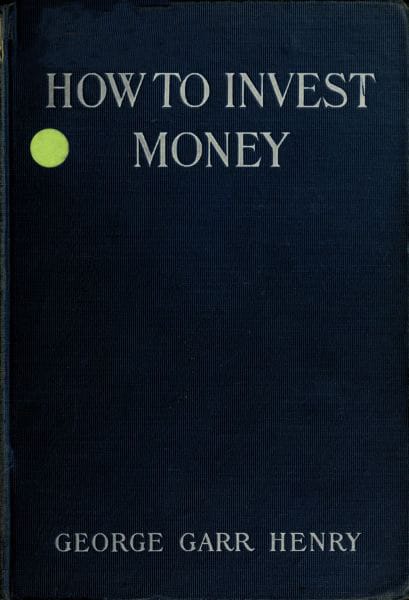
What makes this book matter: it offers a window into how investors thought about money before the Great Depression, before modern portfolio theory, before index funds. Yet the fundamental principles remain unchanged: risk, diversification, the eternal tension between safety and return. The book: Written by investment banker George Garr Henry, this early 20th century guide spoke directly to ordinary Americans who suddenly found themselves with surplus capital to deploy. Henry walks through bonds, stocks, and the mathematics of risk distribution with the clarity of a man who had seen fortunes made and lost. He addresses the double challenge facing his readers: protecting what they have while making it grow. Why it endures: this isn't a get-rich-quick manual. It's a time capsule of financial wisdom from an era when investing was still new to millions. The logic crackles with relevance, even as the specific securities feel historical. For anyone curious about where modern investing came from, this is a direct line to the source. Who it's for: readers interested in economic history, investors curious about the origins of portfolio theory, anyone who enjoys seeing how much and how little has changed.
Editions
X-Ray
“The investment of money is a banker's business.””
— George Garr Henry
Link to this book
Add a free, dofollow link to Lex on your blog, forum, syllabus, or reading list.

<a href="https://lex-books.com/book/how-to-invest-money-80c5aac0-46c2-4d56-a0bf-f3bcb9643e6b"><img src="https://lex-books.com/badges/read-on-lex.svg" alt="Read How to Invest Money by George Garr Henry free on Lex" width="160" height="40"></a>[](https://lex-books.com/book/how-to-invest-money-80c5aac0-46c2-4d56-a0bf-f3bcb9643e6b)[url=https://lex-books.com/book/how-to-invest-money-80c5aac0-46c2-4d56-a0bf-f3bcb9643e6b][img]https://lex-books.com/badges/read-on-lex.svg[/img][/url]Read How to Invest Money by George Garr Henry free on Lex: https://lex-books.com/book/how-to-invest-money-80c5aac0-46c2-4d56-a0bf-f3bcb9643e6bCite this book
Reading this edition for a paper or guide? Copy a citation.
Henry, George Garr. How to Invest Money. Lex, lex-books.com/book/how-to-invest-money-80c5aac0-46c2-4d56-a0bf-f3bcb9643e6b.Henry, G. G. (n.d.). How to Invest Money. Lex. https://lex-books.com/book/how-to-invest-money-80c5aac0-46c2-4d56-a0bf-f3bcb9643e6bHenry, George Garr. How to Invest Money. Lex. https://lex-books.com/book/how-to-invest-money-80c5aac0-46c2-4d56-a0bf-f3bcb9643e6b.