Handicaps of Childhood
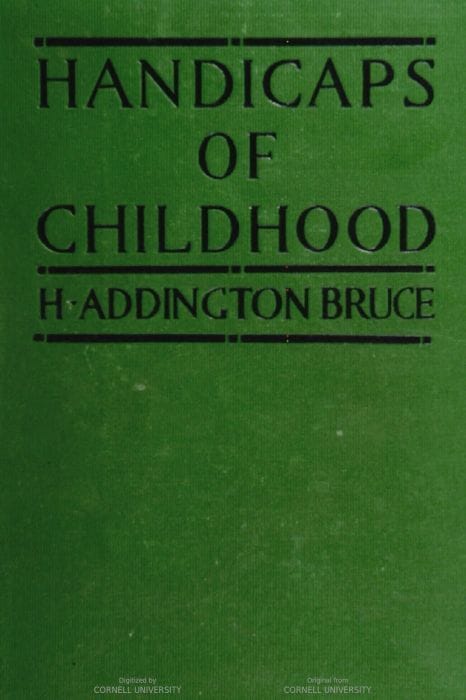
Long before modern psychology legitimized what we now call attachment theory and adverse childhood experiences, H. Addington Bruce argued something radical: the first years of life cast a shadow that stretches across an entire existence. Written in the early twentieth century, Handicaps of Childhood makes the case that emotional and behavioral problems in children are not innate curses but rather the harvest of parental neglect. Bruce contends that the seeds of empathy, self-control, and moral reasoning must be planted early by mothers and fathers who understand their profound responsibility. Those who fail to nurture these qualities in childhood, he warns, condemn their offspring to lifelong disadvantages that no amount of later remediation can fully cure. While some of Bruce's specific recommendations reflect the Victorian attitudes of his era, the book's central insight feels startlingly contemporary: the way we raise our children determines the adults they become. For readers interested in the intellectual history of child psychology or the evolution of parenting philosophy, this work offers a fascinating window into how one early thinker understood the stakes of early childhood development.
Editions
Link to this book
Add a free, dofollow link to Lex on your blog, forum, syllabus, or reading list.

<a href="https://lex-books.com/book/handicaps-of-childhood-21a49a29-20c4-43a1-b42e-c41853f6abd1"><img src="https://lex-books.com/badges/read-on-lex.svg" alt="Read Handicaps of Childhood by H. Addington Bruce free on Lex" width="160" height="40"></a>[](https://lex-books.com/book/handicaps-of-childhood-21a49a29-20c4-43a1-b42e-c41853f6abd1)[url=https://lex-books.com/book/handicaps-of-childhood-21a49a29-20c4-43a1-b42e-c41853f6abd1][img]https://lex-books.com/badges/read-on-lex.svg[/img][/url]Read Handicaps of Childhood by H. Addington Bruce free on Lex: https://lex-books.com/book/handicaps-of-childhood-21a49a29-20c4-43a1-b42e-c41853f6abd1Cite this book
Reading this edition for a paper or guide? Copy a citation.
Bruce, H. Addington. Handicaps of Childhood. Lex, lex-books.com/book/handicaps-of-childhood-21a49a29-20c4-43a1-b42e-c41853f6abd1.Bruce, H. A. (n.d.). Handicaps of Childhood. Lex. https://lex-books.com/book/handicaps-of-childhood-21a49a29-20c4-43a1-b42e-c41853f6abd1Bruce, H. Addington. Handicaps of Childhood. Lex. https://lex-books.com/book/handicaps-of-childhood-21a49a29-20c4-43a1-b42e-c41853f6abd1.