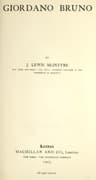
Giordano Bruno
1903

Giordano Bruno
1903
In 1600, the Roman Inquisition burned a man alive for suggesting the universe might be too vast to have a center. That man was Giordano Bruno, and his execution marked not the end of an idea but the beginning of a myth that still haunts us. McIntyre's 1903 biography traces the arc of a Renaissance mind so dangerous to orthodoxy that even his most radical cosmological insight, the argument that the stars were distant suns surrounded by their own living worlds, became almost secondary to his true heresy: the insistence that the universe was infinite, unbounded, and utterly indifferent to human certainties. McIntyre draws on Berti, Dufour, and Bruno's own works to reconstruct a life that moved from the orchards of Nola to the prisons of the Inquisition, from the court of Elizabeth I to the stake at Campo de' Fiori. The second half lets Bruno speak for himself, offering not a systematic treatise but a window into a sixteenth-century mind wrestling with problems that would not be safely revisited for centuries. Bruno's crime was not merely science; it was the refusal to accept that any authority could map the infinite.
Editions
Link to this book
Add a free, dofollow link to Lex on your blog, forum, syllabus, or reading list.

<a href="https://lex-books.com/book/giordano-bruno-ab364913-c079-4aeb-9a7e-3166cc563a42"><img src="https://lex-books.com/badges/read-on-lex.svg" alt="Read Giordano Bruno by J. Lewis McIntyre free on Lex" width="160" height="40"></a>[](https://lex-books.com/book/giordano-bruno-ab364913-c079-4aeb-9a7e-3166cc563a42)[url=https://lex-books.com/book/giordano-bruno-ab364913-c079-4aeb-9a7e-3166cc563a42][img]https://lex-books.com/badges/read-on-lex.svg[/img][/url]Read Giordano Bruno by J. Lewis McIntyre free on Lex: https://lex-books.com/book/giordano-bruno-ab364913-c079-4aeb-9a7e-3166cc563a42Cite this book
Reading this edition for a paper or guide? Copy a citation.
McIntyre, J. Lewis. Giordano Bruno. Lex, lex-books.com/book/giordano-bruno-ab364913-c079-4aeb-9a7e-3166cc563a42.McIntyre, J. L. (1903). Giordano Bruno. Lex. https://lex-books.com/book/giordano-bruno-ab364913-c079-4aeb-9a7e-3166cc563a42McIntyre, J. Lewis. Giordano Bruno. Lex. https://lex-books.com/book/giordano-bruno-ab364913-c079-4aeb-9a7e-3166cc563a42.