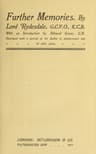
Further Memories
1917
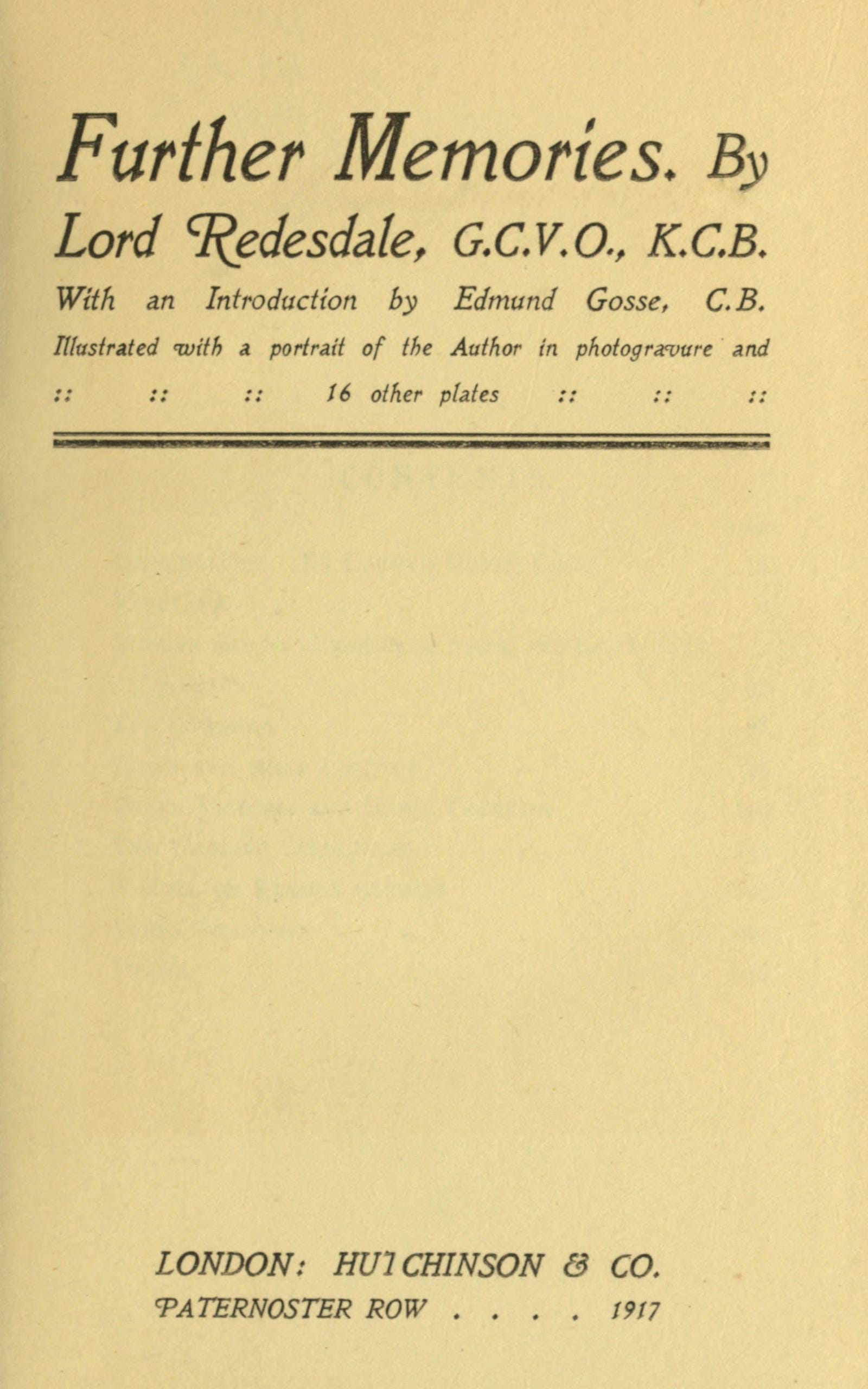
Baron Redesdale was seventy-eight when he began writing the essays that would become his final book, and the age shows not in fading vigor but in accumulated ease. These are the reminiscences of a man who has outlived conventions and now speaks as he pleases, drifting from his beloved Cotswold garden through Buddhist legend, medieval Christian allegory, and sharp observations on caste and revolution. The centerpiece, "Veluvana," finds him in a bamboo grove surrounded by Japanese curios, but what unfolds is something stranger and richer: he retells Buddhist Jataka tales with the casual authority of a Victorian gentleman who has clearly read everything, then pivots to compare Buddha's peaceful revolt against Brahmanical hierarchy with St. Francis, with European revolutions, with whatever strikes his fancy that morning. This is not a systematic work of theology but something more disarming: a cultivated mind in late life,漫游 from the particular to the universal, finding in Eastern wisdom a mirror for Western anxieties. Written during the Great War's final years, the book carries an elegiac, unhurried quality, as if the author knows he is taking his leave and wishes to share what has occupied his thoughts. For readers who cherish the essay tradition at its most personal and digressive, Redesdale offers a last, gentle conversation.
Editions
Link to this book
Add a free, dofollow link to Lex on your blog, forum, syllabus, or reading list.

<a href="https://lex-books.com/book/further-memories-2b3225e3-2d37-490e-b0e2-e754d7e9119e"><img src="https://lex-books.com/badges/read-on-lex.svg" alt="Read Further Memories by Algernon Bertram Freeman-Mitford, Baron Redesdale free on Lex" width="160" height="40"></a>[](https://lex-books.com/book/further-memories-2b3225e3-2d37-490e-b0e2-e754d7e9119e)[url=https://lex-books.com/book/further-memories-2b3225e3-2d37-490e-b0e2-e754d7e9119e][img]https://lex-books.com/badges/read-on-lex.svg[/img][/url]Read Further Memories by Algernon Bertram Freeman-Mitford, Baron Redesdale free on Lex: https://lex-books.com/book/further-memories-2b3225e3-2d37-490e-b0e2-e754d7e9119eCite this book
Reading this edition for a paper or guide? Copy a citation.
Algernon Bertram Freeman-Mitford, Baron Redesdale. Further Memories. Lex, lex-books.com/book/further-memories-2b3225e3-2d37-490e-b0e2-e754d7e9119e.Algernon Bertram Freeman-Mitford, B. R. (1917). Further Memories. Lex. https://lex-books.com/book/further-memories-2b3225e3-2d37-490e-b0e2-e754d7e9119eAlgernon Bertram Freeman-Mitford, Baron Redesdale. Further Memories. Lex. https://lex-books.com/book/further-memories-2b3225e3-2d37-490e-b0e2-e754d7e9119e.