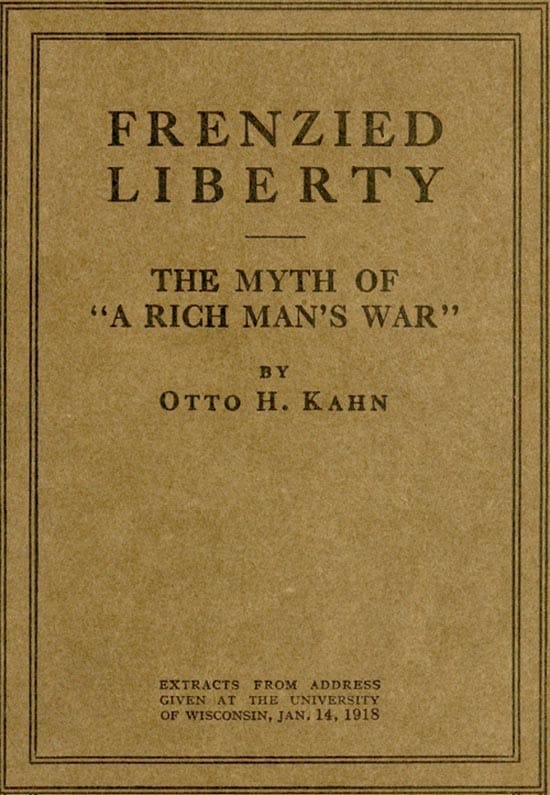
Frenzied Liberty; The Myth of "A Rich Man's War
1918
Frenzied Liberty; The Myth of "A Rich Man's War
1918
In 1918, as America grinds through its second year of European war, a provocative counter-narrative emerges from an unexpected voice. Otto H. Kahn, a German-American banker and one of the wealthiest men in America, takes direct aim at the growing radical critique that the Great War is merely a "rich man's war" being fought by the poor. With passionate urgency, Kahn argues that this framing is not just false but dangerously corrosive to national unity. He dissects the logic of those who claim big business orchestrated the conflict for profit, contending instead that commerce and industry would suffer, not flourish, from prolonged global conflict. The book stands as a fiercely argued defense of America's intervention, framed not as imperialism but as a necessary stand against tyranny and for democratic ideals. Yet it is more than propaganda: Kahn weaves in a philosophy of individualism tempered by genuine social responsibility, warning that extremist movements capitalizing on class resentment pose their own grave threats to the American experiment. Written in ornate, ringing prose, this is a historical document that captures the anxieties and convictions of a nation at war with itself about why it fights.
Editions
Link to this book
Add a free, dofollow link to Lex on your blog, forum, syllabus, or reading list.

<a href="https://lex-books.com/book/frenzied-liberty-the-myth-of-a-rich-man-s-war-49895ec4-4c8c-4d6f-adcf-5c3fabfbde28"><img src="https://lex-books.com/badges/read-on-lex.svg" alt="Read Frenzied Liberty; The Myth of "A Rich Man's War by Otto H. Kahn free on Lex" width="160" height="40"></a>[](https://lex-books.com/book/frenzied-liberty-the-myth-of-a-rich-man-s-war-49895ec4-4c8c-4d6f-adcf-5c3fabfbde28)[url=https://lex-books.com/book/frenzied-liberty-the-myth-of-a-rich-man-s-war-49895ec4-4c8c-4d6f-adcf-5c3fabfbde28][img]https://lex-books.com/badges/read-on-lex.svg[/img][/url]Read Frenzied Liberty; The Myth of "A Rich Man's War by Otto H. Kahn free on Lex: https://lex-books.com/book/frenzied-liberty-the-myth-of-a-rich-man-s-war-49895ec4-4c8c-4d6f-adcf-5c3fabfbde28Cite this book
Reading this edition for a paper or guide? Copy a citation.
Kahn, Otto H.. Frenzied Liberty; The Myth of "A Rich Man's War. Lex, lex-books.com/book/frenzied-liberty-the-myth-of-a-rich-man-s-war-49895ec4-4c8c-4d6f-adcf-5c3fabfbde28.Kahn, O. H. (1918). Frenzied Liberty; The Myth of "A Rich Man's War. Lex. https://lex-books.com/book/frenzied-liberty-the-myth-of-a-rich-man-s-war-49895ec4-4c8c-4d6f-adcf-5c3fabfbde28Kahn, Otto H.. Frenzied Liberty; The Myth of "A Rich Man's War. Lex. https://lex-books.com/book/frenzied-liberty-the-myth-of-a-rich-man-s-war-49895ec4-4c8c-4d6f-adcf-5c3fabfbde28.