Easy Lessons in Einstein: A Discussion of the More Intelligible Features of the Theory of Relativity
1920
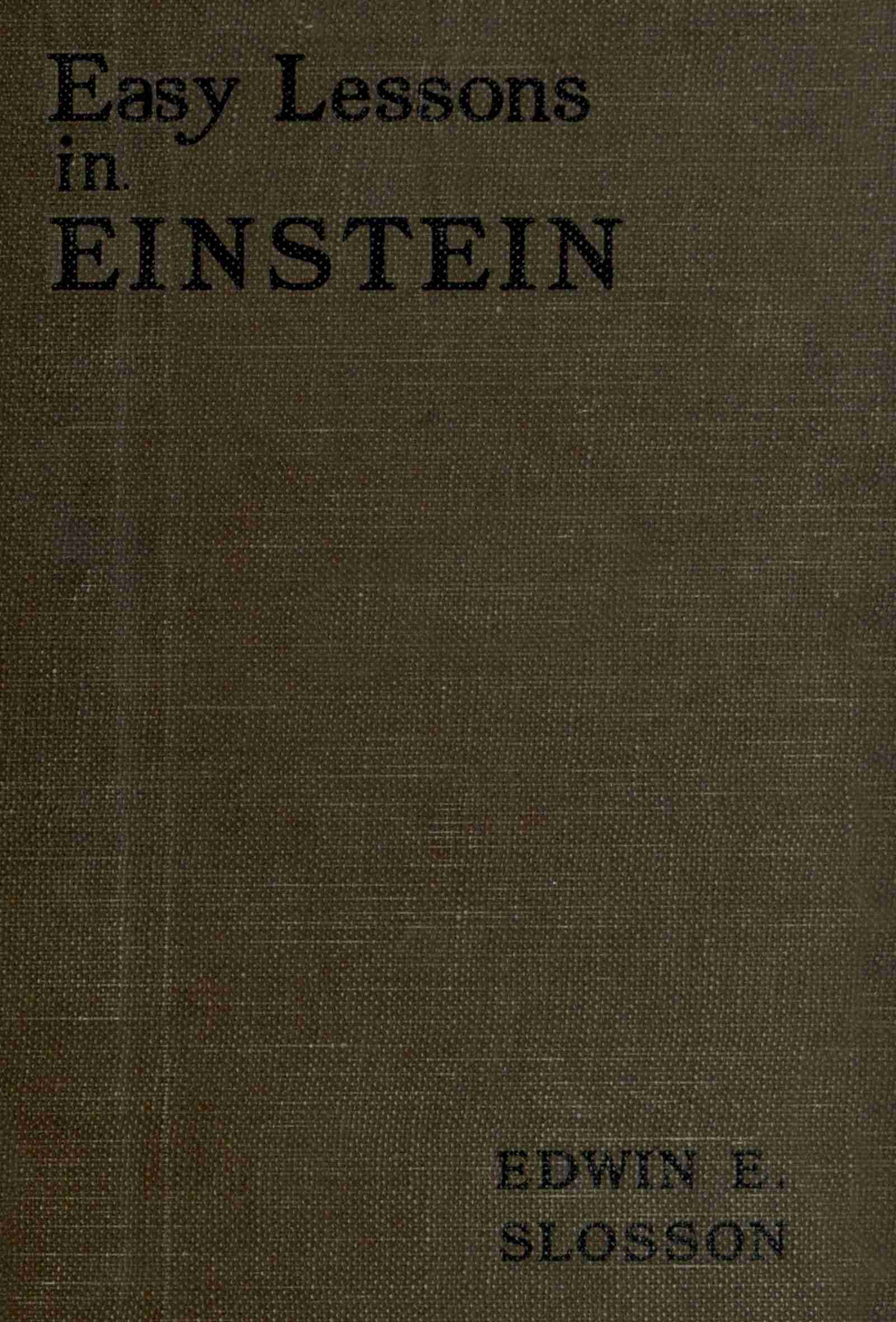
Easy Lessons in Einstein: A Discussion of the More Intelligible Features of the Theory of Relativity
1920
Easy Lessons in Einstein, published in 1920 by Edwin E. Slosson, is a scientific work that simplifies the complex concepts of Einstein's theory of relativity for a general audience. The book employs a conversational format between a curious reader and the author to demystify relativity, discussing its foundational ideas, paradoxes, and philosophical implications. Slosson contextualizes Einstein's theories through historical experiments, such as the 1919 solar eclipse, and uses relatable analogies to explain concepts like the relativity of motion and the nature of time. This accessible approach makes the groundbreaking ideas of relativity comprehensible to non-specialists.
Editions
Link to this book
Add a free, dofollow link to Lex on your blog, forum, syllabus, or reading list.

<a href="https://lex-books.com/book/easy-lessons-in-einstein-a-discussion-of-the-more-intelligible-features-of-the-t-02b56fdc-0735-4a82-9371-cb74cf5c1386"><img src="https://lex-books.com/badges/read-on-lex.svg" alt="Read Easy Lessons in Einstein: A Discussion of the More Intelligible Features of the Theory of Relativity by Edwin E. Slosson free on Lex" width="160" height="40"></a>[](https://lex-books.com/book/easy-lessons-in-einstein-a-discussion-of-the-more-intelligible-features-of-the-t-02b56fdc-0735-4a82-9371-cb74cf5c1386)[url=https://lex-books.com/book/easy-lessons-in-einstein-a-discussion-of-the-more-intelligible-features-of-the-t-02b56fdc-0735-4a82-9371-cb74cf5c1386][img]https://lex-books.com/badges/read-on-lex.svg[/img][/url]Read Easy Lessons in Einstein: A Discussion of the More Intelligible Features of the Theory of Relativity by Edwin E. Slosson free on Lex: https://lex-books.com/book/easy-lessons-in-einstein-a-discussion-of-the-more-intelligible-features-of-the-t-02b56fdc-0735-4a82-9371-cb74cf5c1386Cite this book
Reading this edition for a paper or guide? Copy a citation.
Slosson, Edwin E.. Easy Lessons in Einstein: A Discussion of the More Intelligible Features of the Theory of Relativity. Lex, lex-books.com/book/easy-lessons-in-einstein-a-discussion-of-the-more-intelligible-features-of-the-t-02b56fdc-0735-4a82-9371-cb74cf5c1386.Slosson, E. E. (1920). Easy Lessons in Einstein: A Discussion of the More Intelligible Features of the Theory of Relativity. Lex. https://lex-books.com/book/easy-lessons-in-einstein-a-discussion-of-the-more-intelligible-features-of-the-t-02b56fdc-0735-4a82-9371-cb74cf5c1386Slosson, Edwin E.. Easy Lessons in Einstein: A Discussion of the More Intelligible Features of the Theory of Relativity. Lex. https://lex-books.com/book/easy-lessons-in-einstein-a-discussion-of-the-more-intelligible-features-of-the-t-02b56fdc-0735-4a82-9371-cb74cf5c1386.