Doctrina Christiana: The First Book Printed in the Philippines, Manila, 1593.
1649
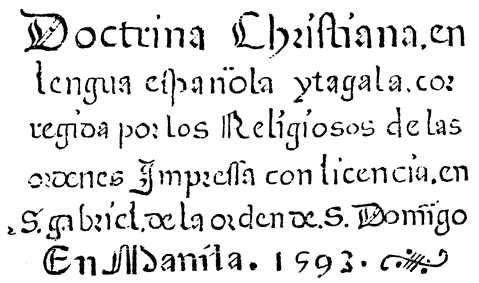
Doctrina Christiana: The First Book Printed in the Philippines, Manila, 1593.
1649
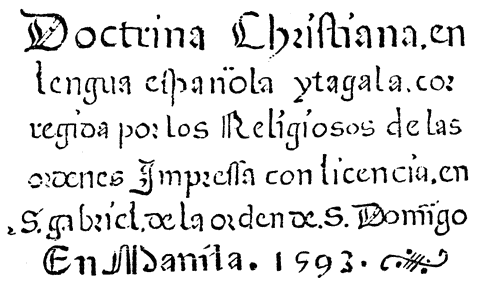
In 1593, in a Manila press barely three years old, a small book emerged that would become the first printed in the Philippines. This is that book: a catechism intended to teach the fundamentals of Christian doctrine to the native population, rendered in parallel Spanish and Tagalog text. The work represents a remarkable convergence of empire, evangelization, and the nascent technology of printing in Asia. Beyond its religious purpose, it stands as one of the earliest extant examples of Tagalog in printed form, a linguistic artifact of enormous cultural value. This edition reproduces the foundational 1593 text alongside scholarly analysis of its physical characteristics, printing methods, and the mysterious circumstances of its creation. The quest to locate surviving copies of this ghost book reads like scholarly detective work, given how few survived centuries of tropical climate, war, and neglect. In 2024, it was inscribed in the UNESCO Memory of the World Register, recognizing its singular importance to the documentary heritage of Asia. For anyone interested in the history of the book, colonial encounter, or the roots of Filipino literary culture, this is where the story begins.
Editions

X-Ray
“We made bad use of immortality, and so ended up dying; Christ made good use of mortality, so that we might end up living.””
— Unknown
“Whoever, then, thinks that he understands the Holy Scriptures, or any part of them, but puts such an interpretation upon them as does not tend to build up this twofold love of God and our neighbor, does not yet understand them as he ought.””
— Unknown
“So anyone who thinks that he has understood the divine scriptures or any part of them, but cannot by his understanding build up this double love of God and neighbor, has not yet succeeded in understanding them.””
— Unknown
“For no one should consider anything his own, except perhaps a lie, since all truth is from Him who said, "I am the truth.””
— Unknown
“Some things are to be enjoyed, others to be used, and there are others to be enjoyed and used.””
— Unknown
“The wisdom of what a person says is in direct proportion to his progress in learning the holy scriptures--and I am not speaking of intensive reading or memorization, but real understanding and careful investigation of their meaning. Some people read them but neglect them; by their reading they profit in knowledge, by their neglect they forfeit understanding.””
— Unknown
“Further, all men are to be loved equally. But since you cannot do good to all, you are to pay special regard to those who, by the accidents of time, or place, or circumstance, are brought into closer connection with you. For, suppose that you had a great deal of some commodity, and felt bound to give it away to somebody who had none, and that it could not be given to more than one person; if two persons presented themselves, neither of whom had either from need or relationship a greater claim upon you than the other, you could do nothing fairer than choose by lot to which you would give what could not be given to both. Just so among men: since you cannot consult for the good of them all, you must take the matter as decided for you by a sort of lot, according as each man happens for the time being to be more closely connected with you.Book 1, Chapter 28 - How we are to decide whom to aid””
— Unknown
“Between temporal and eternal things there is this difference: a temporal thing is loved more before we have it, and it begins to grow worthless when we gain it, for it does not satisfy the soul, whose true and certain rest is eternity; but the eternal is more ardently loved when it is acquired than when it is merely desired.””
— Unknown
“Faith will falter if the authority of holy scripture is shaken; and if faith falters, love itself decays. For if someone lapses in his faith, he inevitably lapses in his love as well, since he cannot love what he does not believe to be true.””
— Unknown
Link to this book
Add a free, dofollow link to Lex on your blog, forum, syllabus, or reading list.

<a href="https://lex-books.com/book/doctrina-christiana-the-first-book-printed-in-the-philippines-manila-1593-927dd60f-aef1-4745-a37b-19bde1754589"><img src="https://lex-books.com/badges/read-on-lex.svg" alt="Read Doctrina Christiana: The First Book Printed in the Philippines, Manila, 1593. by Unknown free on Lex" width="160" height="40"></a>[](https://lex-books.com/book/doctrina-christiana-the-first-book-printed-in-the-philippines-manila-1593-927dd60f-aef1-4745-a37b-19bde1754589)[url=https://lex-books.com/book/doctrina-christiana-the-first-book-printed-in-the-philippines-manila-1593-927dd60f-aef1-4745-a37b-19bde1754589][img]https://lex-books.com/badges/read-on-lex.svg[/img][/url]Read Doctrina Christiana: The First Book Printed in the Philippines, Manila, 1593. by Unknown free on Lex: https://lex-books.com/book/doctrina-christiana-the-first-book-printed-in-the-philippines-manila-1593-927dd60f-aef1-4745-a37b-19bde1754589Cite this book
Reading this edition for a paper or guide? Copy a citation.
Unknown. Doctrina Christiana: The First Book Printed in the Philippines, Manila, 1593.. Lex, lex-books.com/book/doctrina-christiana-the-first-book-printed-in-the-philippines-manila-1593-927dd60f-aef1-4745-a37b-19bde1754589.Unknown (1649). Doctrina Christiana: The First Book Printed in the Philippines, Manila, 1593.. Lex. https://lex-books.com/book/doctrina-christiana-the-first-book-printed-in-the-philippines-manila-1593-927dd60f-aef1-4745-a37b-19bde1754589Unknown. Doctrina Christiana: The First Book Printed in the Philippines, Manila, 1593.. Lex. https://lex-books.com/book/doctrina-christiana-the-first-book-printed-in-the-philippines-manila-1593-927dd60f-aef1-4745-a37b-19bde1754589.