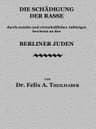
Die Schädigung Der Rassedurch Soziales Und Wirtschaftliches Aufsteigen Bewiesen an Den Berliner Juden

Die Schädigung Der Rassedurch Soziales Und Wirtschaftliches Aufsteigen Bewiesen an Den Berliner Juden
A scientific publication written in the early 20th century. The text focuses on the demographic and social conditions affecting the Jewish population in Berlin, specifically examining the implications of socio-economic advancements on their reproductive rates and overall population dynamics. Theilhaber explores themes of race hygiene and the complexities of urban Jewish life, positioning his work within the broader discourse of eugenics that was prevalent during his time. At the start of this treatise, Theilhaber introduces the concept of racial hygiene and sets up a discussion regarding the Jewish community in Berlin, noting a significant increase in their population due to migration from rural areas of Prussia and beyond. He presents initial statistics depicting the Jewish population growth while simultaneously establishing a worrying trend concerning declining birth rates among Jews in urban settings. Through a detailed analysis of demographic data, including birth rates and marriage patterns, he aims to substantiate his argument that socio-economic conditions, rather than inherent biological factors, have contributed to these changes in reproductive behavior within the Jewish community.
Editions
Link to this book
Add a free, dofollow link to Lex on your blog, forum, syllabus, or reading list.

<a href="https://lex-books.com/book/die-sch-digung-der-rassedurch-soziales-und-wirtschaftliches-aufsteigen-bewiesen--ca34917c-a597-46bc-bd6c-a53fdc27a364"><img src="https://lex-books.com/badges/read-on-lex.svg" alt="Read Die Schädigung Der Rassedurch Soziales Und Wirtschaftliches Aufsteigen Bewiesen an Den Berliner Juden by Felix A. Theilhaber free on Lex" width="160" height="40"></a>[](https://lex-books.com/book/die-sch-digung-der-rassedurch-soziales-und-wirtschaftliches-aufsteigen-bewiesen--ca34917c-a597-46bc-bd6c-a53fdc27a364)[url=https://lex-books.com/book/die-sch-digung-der-rassedurch-soziales-und-wirtschaftliches-aufsteigen-bewiesen--ca34917c-a597-46bc-bd6c-a53fdc27a364][img]https://lex-books.com/badges/read-on-lex.svg[/img][/url]Read Die Schädigung Der Rassedurch Soziales Und Wirtschaftliches Aufsteigen Bewiesen an Den Berliner Juden by Felix A. Theilhaber free on Lex: https://lex-books.com/book/die-sch-digung-der-rassedurch-soziales-und-wirtschaftliches-aufsteigen-bewiesen--ca34917c-a597-46bc-bd6c-a53fdc27a364Cite this book
Reading this edition for a paper or guide? Copy a citation.
Theilhaber, Felix A.. Die Schädigung Der Rassedurch Soziales Und Wirtschaftliches Aufsteigen Bewiesen an Den Berliner Juden. Lex, lex-books.com/book/die-sch-digung-der-rassedurch-soziales-und-wirtschaftliches-aufsteigen-bewiesen--ca34917c-a597-46bc-bd6c-a53fdc27a364.Theilhaber, F. A. (n.d.). Die Schädigung Der Rassedurch Soziales Und Wirtschaftliches Aufsteigen Bewiesen an Den Berliner Juden. Lex. https://lex-books.com/book/die-sch-digung-der-rassedurch-soziales-und-wirtschaftliches-aufsteigen-bewiesen--ca34917c-a597-46bc-bd6c-a53fdc27a364Theilhaber, Felix A.. Die Schädigung Der Rassedurch Soziales Und Wirtschaftliches Aufsteigen Bewiesen an Den Berliner Juden. Lex. https://lex-books.com/book/die-sch-digung-der-rassedurch-soziales-und-wirtschaftliches-aufsteigen-bewiesen--ca34917c-a597-46bc-bd6c-a53fdc27a364.