Crimes of Preachers in the United States and Canada
1883
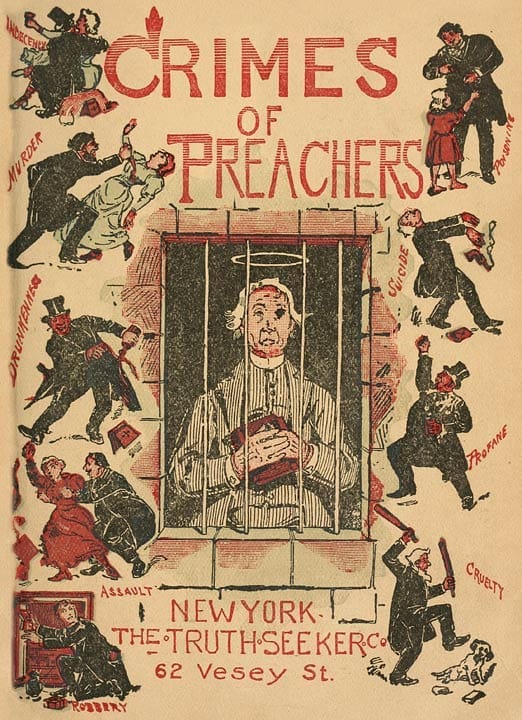
Crimes of Preachers in the United States and Canada
1883
In 1883, actor Henry E. Dixey made a wager that would have been unthinkable a generation earlier: he challenged ministers to prove their moral standards exceeded those of actors, a profession Victorian society deemed morally suspect. M.E. Billings seized upon this challenge, compiling a meticulous record of clergymen who fell far short of the ideals they proclaimed. The result is a disturbing catalog of sexual misconduct, financial crimes, and spiritual betrayal among those trusted to lead American and Canadian communities. Billings argued that society's reverence for clergy created a dangerous shield against scrutiny, allowing transgressions to pass unpunished simply because the perpetrator wore a clerical collar. This is not a modern exposé but a Victorian artifact, revealing a culture beginning to question the moral authority it had long accepted without question. For readers interested in the history of institutional accountability, the evolution of clerical power, or the cracks appearing in 19th-century religious deference, Billings' unflinching compilation offers a window into a pivotal cultural shift.
Editions
X-Ray
“He conceives of divine mercy as infinite -- there is no reaching the end of it; hence with unlimited credit he may draw on his account whenever he feels sinfully disposed.””
— M. E. Billings
“Every courtesy was shown the clerical violator of childhood.””
— M. E. Billings
“Over five years ago such a preacher boasted in his farewell sermon that all his bills were paid in the village, and he 'owed not any man'; he should have said that he had paid not any man, and some of his bills are still unpaid.””
— M. E. Billings
Link to this book
Add a free, dofollow link to Lex on your blog, forum, syllabus, or reading list.

<a href="https://lex-books.com/book/crimes-of-preachers-in-the-united-states-and-canada-7effef88-7269-4d34-84d1-ac649e99e3e5"><img src="https://lex-books.com/badges/read-on-lex.svg" alt="Read Crimes of Preachers in the United States and Canada by M. E. Billings free on Lex" width="160" height="40"></a>[](https://lex-books.com/book/crimes-of-preachers-in-the-united-states-and-canada-7effef88-7269-4d34-84d1-ac649e99e3e5)[url=https://lex-books.com/book/crimes-of-preachers-in-the-united-states-and-canada-7effef88-7269-4d34-84d1-ac649e99e3e5][img]https://lex-books.com/badges/read-on-lex.svg[/img][/url]Read Crimes of Preachers in the United States and Canada by M. E. Billings free on Lex: https://lex-books.com/book/crimes-of-preachers-in-the-united-states-and-canada-7effef88-7269-4d34-84d1-ac649e99e3e5Cite this book
Reading this edition for a paper or guide? Copy a citation.
Billings, M. E.. Crimes of Preachers in the United States and Canada. Lex, lex-books.com/book/crimes-of-preachers-in-the-united-states-and-canada-7effef88-7269-4d34-84d1-ac649e99e3e5.Billings, M. E. (1883). Crimes of Preachers in the United States and Canada. Lex. https://lex-books.com/book/crimes-of-preachers-in-the-united-states-and-canada-7effef88-7269-4d34-84d1-ac649e99e3e5Billings, M. E.. Crimes of Preachers in the United States and Canada. Lex. https://lex-books.com/book/crimes-of-preachers-in-the-united-states-and-canada-7effef88-7269-4d34-84d1-ac649e99e3e5.