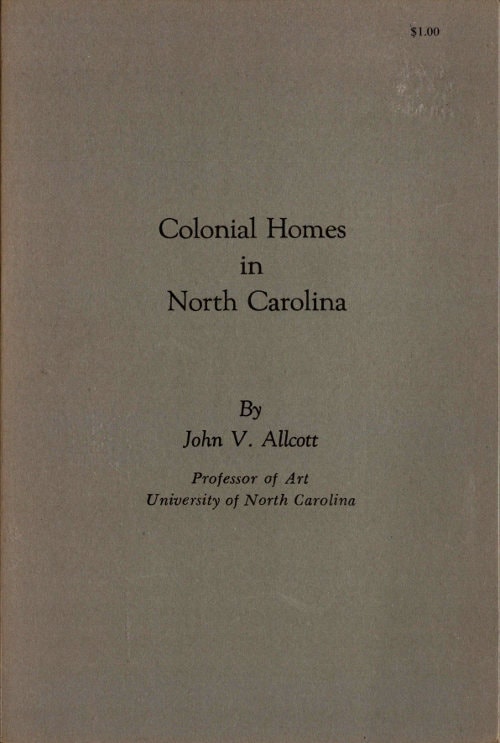
Colonial Homes in North Carolina
1963
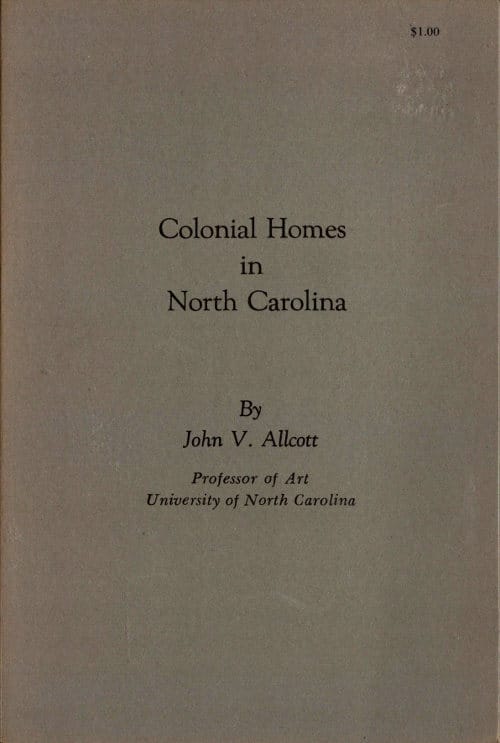
Long after the political structures of colonial North Carolina dissolved, the houses remained. This 1963 volume by architectural historian John V. Allcott serves as both a field guide and an act of preservation, tracing the built environment of the Albemarle and Piedmont regions from the early 1700s through the Revolution. Allcott begins not with bricks and mortar but with maps from above: aerial perspectives that reveal how settlements spread and shifted, how topography dictated where life took root. From there, he moves to the houses themselves, examining timber frames hewn from local forests, brick patterns fired from Carolina clay, and the gradual emergence of Georgian formality as colonial wealth accumulated. These are not mere structures but arguments about identity, written by settlers who blended English traditions with Carolina necessities. Allcott writes for a reader who sees a weathered colonial house and wants to understand not just its style, but who knelt in its yards, what crops grew in its fields, and why certain beams still bear the marks of axes swung three centuries ago. The book remains essential for anyone drawn to the physical traces of American history.
Editions
Link to this book
Add a free, dofollow link to Lex on your blog, forum, syllabus, or reading list.

<a href="https://lex-books.com/book/colonial-homes-in-north-carolina-47185364-33ed-4c40-a769-287c0ee120f5"><img src="https://lex-books.com/badges/read-on-lex.svg" alt="Read Colonial Homes in North Carolina by John V. Allcott free on Lex" width="160" height="40"></a>[](https://lex-books.com/book/colonial-homes-in-north-carolina-47185364-33ed-4c40-a769-287c0ee120f5)[url=https://lex-books.com/book/colonial-homes-in-north-carolina-47185364-33ed-4c40-a769-287c0ee120f5][img]https://lex-books.com/badges/read-on-lex.svg[/img][/url]Read Colonial Homes in North Carolina by John V. Allcott free on Lex: https://lex-books.com/book/colonial-homes-in-north-carolina-47185364-33ed-4c40-a769-287c0ee120f5Cite this book
Reading this edition for a paper or guide? Copy a citation.
Allcott, John V.. Colonial Homes in North Carolina. Lex, lex-books.com/book/colonial-homes-in-north-carolina-47185364-33ed-4c40-a769-287c0ee120f5.Allcott, J. V. (1963). Colonial Homes in North Carolina. Lex. https://lex-books.com/book/colonial-homes-in-north-carolina-47185364-33ed-4c40-a769-287c0ee120f5Allcott, John V.. Colonial Homes in North Carolina. Lex. https://lex-books.com/book/colonial-homes-in-north-carolina-47185364-33ed-4c40-a769-287c0ee120f5.