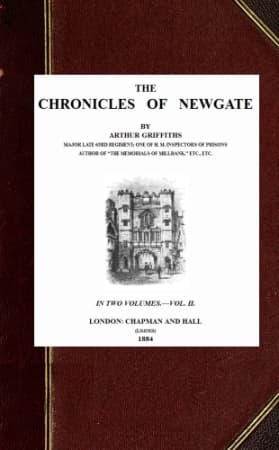
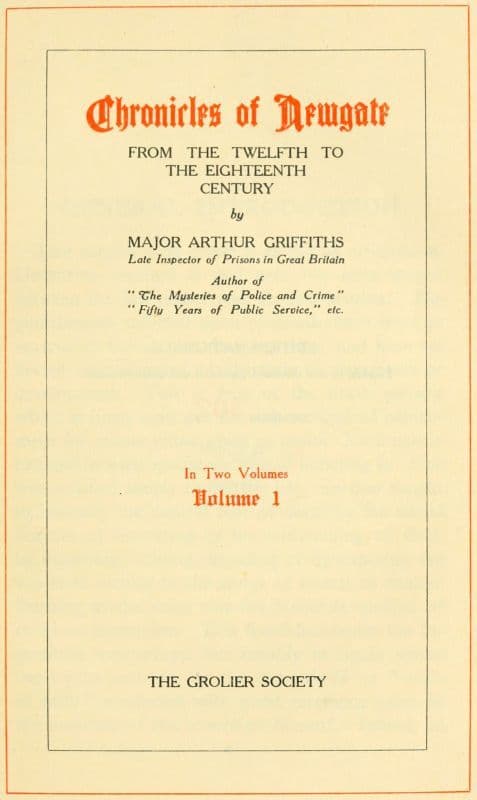
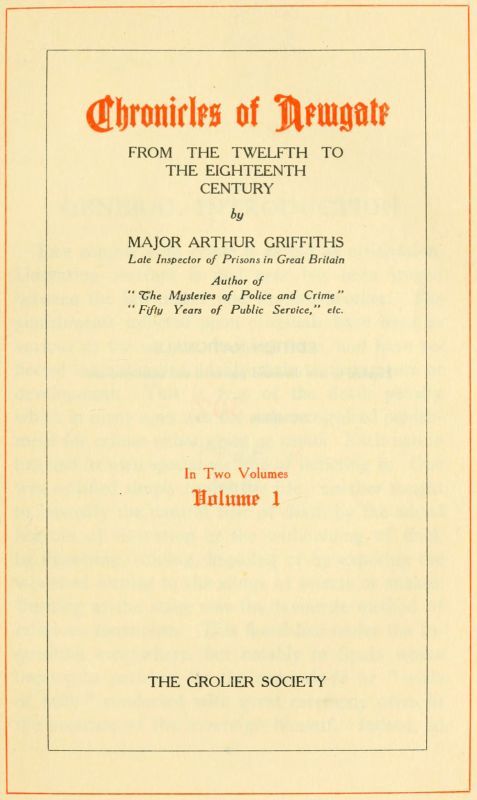
Chronicles of Newgate, Vol. 1from the Twelfth to the Eighteenth Century
1884
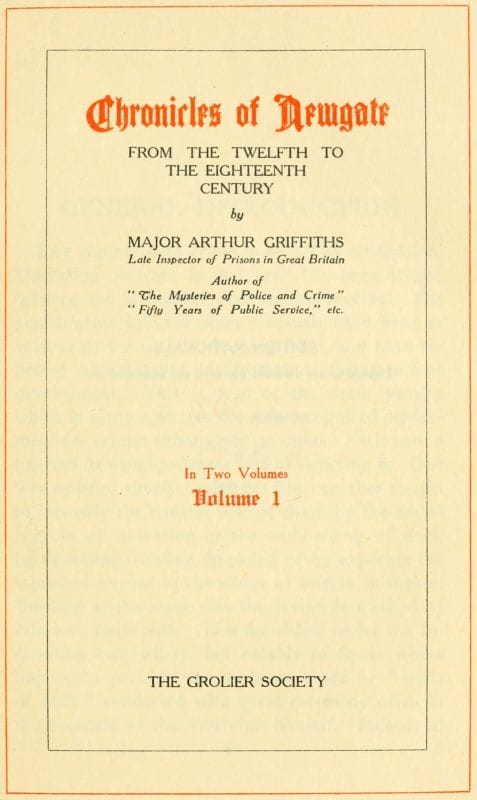
Chronicles of Newgate, Vol. 1from the Twelfth to the Eighteenth Century
1884
A historical account written in the late 19th century. The work provides an in-depth exploration of Newgate Prison, focusing on its history from the twelfth to the eighteenth century, examining the lives of its inmates and the societal implications of crime and punishment during that era. The opening of the narrative sets a tone of grim reflection on the brutal history of penal practices, illustrating the stark realities faced by those imprisoned within Newgate's walls. Griffiths introduces the prison as a place of suffering where individuals, regardless of their social class, faced dire conditions, often dependent on charity for their survival. Early mentions highlight the treatment of both political and common criminals, and the text hints at the dramatic stories that will unfold through the lens of notable prisoners and the evolution of justice within this infamous institution.
Editions
X-Ray
Quaker lady and prison reformer who worked to improve conditions for women prisoners in Newgate in 1813. She formed the Ladies' Committee and secured important reforms from Parliament.
Major and former Inspector of Prisons in Great Britain, author of this historical chronicle. He provides detailed accounts of Newgate's history from the 12th to 18th centuries.
Famous young criminal and escape artist who became notorious for his multiple escapes from Newgate in 1724. A carpenter by trade, he was executed at age 22 after becoming a celebrity.
Brutal keeper of Newgate during Mary's reign, described as 'a perfect type of the brutal gaoler.' He was cruel to religious prisoners and demanded excessive fees.
About Chronicles of Newgate, Vol. 1from the Twelfth to the Eighteenth Century
Chapter Summaries
- Introduction
- Establishes the universal nature of crime and punishment throughout history, describing various methods of execution and torture used by different civilizations. Sets the stage for examining England's more humane approach through the lens of Newgate prison.
- 1
- Chronicles the earliest history of Newgate from the 12th century, describing its origins as both city gate and prison. Details the types of prisoners, the gradual transfer of control to city authorities, and the deplorable conditions that persisted for centuries.
- 2
- Covers the Tudor period with focus on religious persecution under Henry VIII and Mary I. Details the imprisonment and martyrdom of Protestant reformers, the brutal conditions under gaoler Alexander, and the beginning of more systematic record-keeping.
Key Themes
- Justice vs. Injustice
- The work explores how justice was administered through the ages, showing both legitimate punishment of criminals and the persecution of innocent victims of political and religious intolerance.
- Religious Persecution
- A major theme covering the imprisonment and execution of religious dissidents under various monarchs, from Protestant martyrs under Mary to Catholics under Elizabeth and beyond.
- Prison Reform
- The gradual evolution from brutal medieval conditions to more humane treatment, exemplified by reformers like Elizabeth Fry and John Howard who worked to improve prisoner welfare.
Characters
- Elizabeth Fry(major)
- Quaker lady and prison reformer who worked to improve conditions for women prisoners in Newgate in 1813. She formed the Ladies' Committee and secured important reforms from Parliament.
- Arthur Griffiths(protagonist)
- Major and former Inspector of Prisons in Great Britain, author of this historical chronicle. He provides detailed accounts of Newgate's history from the 12th to 18th centuries.
- Jack Sheppard(major)
- Famous young criminal and escape artist who became notorious for his multiple escapes from Newgate in 1724. A carpenter by trade, he was executed at age 22 after becoming a celebrity.
- Alexander (the gaoler)(antagonist)
- Brutal keeper of Newgate during Mary's reign, described as 'a perfect type of the brutal gaoler.' He was cruel to religious prisoners and demanded excessive fees.
- John Rogers(major)
- Vicar and prebendary who was the first Protestant martyr under Mary's reign. He was imprisoned in Newgate for a full year before being executed at Smithfield in 1555.
- Anne Askew(major)
- Protestant martyr and daughter of Sir William Askew. She was tortured in the Tower and imprisoned in Newgate before being burned at Smithfield for denying the Real Presence.
Link to this book
Add a free, dofollow link to Lex on your blog, forum, syllabus, or reading list.

<a href="https://lex-books.com/book/chronicles-of-newgate-vol-1from-the-twelfth-to-the-eighteenth-century-43d42971-2704-4d5f-a207-d36b6ca6b50f"><img src="https://lex-books.com/badges/read-on-lex.svg" alt="Read Chronicles of Newgate, Vol. 1from the Twelfth to the Eighteenth Century by Arthur Griffiths free on Lex" width="160" height="40"></a>[](https://lex-books.com/book/chronicles-of-newgate-vol-1from-the-twelfth-to-the-eighteenth-century-43d42971-2704-4d5f-a207-d36b6ca6b50f)[url=https://lex-books.com/book/chronicles-of-newgate-vol-1from-the-twelfth-to-the-eighteenth-century-43d42971-2704-4d5f-a207-d36b6ca6b50f][img]https://lex-books.com/badges/read-on-lex.svg[/img][/url]Read Chronicles of Newgate, Vol. 1from the Twelfth to the Eighteenth Century by Arthur Griffiths free on Lex: https://lex-books.com/book/chronicles-of-newgate-vol-1from-the-twelfth-to-the-eighteenth-century-43d42971-2704-4d5f-a207-d36b6ca6b50fCite this book
Reading this edition for a paper or guide? Copy a citation.
Griffiths, Arthur. Chronicles of Newgate, Vol. 1from the Twelfth to the Eighteenth Century. Lex, lex-books.com/book/chronicles-of-newgate-vol-1from-the-twelfth-to-the-eighteenth-century-43d42971-2704-4d5f-a207-d36b6ca6b50f.Griffiths, A. (1884). Chronicles of Newgate, Vol. 1from the Twelfth to the Eighteenth Century. Lex. https://lex-books.com/book/chronicles-of-newgate-vol-1from-the-twelfth-to-the-eighteenth-century-43d42971-2704-4d5f-a207-d36b6ca6b50fGriffiths, Arthur. Chronicles of Newgate, Vol. 1from the Twelfth to the Eighteenth Century. Lex. https://lex-books.com/book/chronicles-of-newgate-vol-1from-the-twelfth-to-the-eighteenth-century-43d42971-2704-4d5f-a207-d36b6ca6b50f.