Über Das Geistige in Der Kunst, Insbesondere in Der Malerei
1912
Über Das Geistige in Der Kunst, Insbesondere in Der Malerei
1912
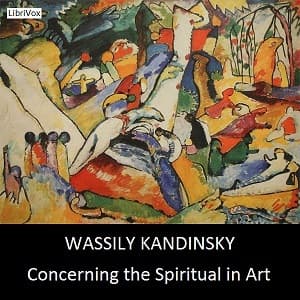
The book that essentially invented abstract art as a theory. Written in 1912 when Kandinsky was at the height of his powers, this is less a manual than a manifesto for a new way of seeing. Kandinsky argues that art must stop copying nature and start expressing the inner spiritual life of the artist. He believed colors possess inherent emotional properties (yellow as anxiety, blue as spirituality, red as energy) and that form shapes meaning. The book traces art's evolution through spiritual epochs, arguing that materialistic modern culture had deadened sensitivity, and that artists must lead the way back to spiritual truth. Though dated in places and occasionally mystical to the point of opacity, it remains the foundational document of abstract expressionism, a radical claim that feeling precedes representation and that the artist's interior world is the only legitimate subject matter.
Editions
X-Ray
“Colour is a power which directly influences the soul.””
— Wassily Kandinsky
“Color directly influences the soul. Color is the keyboard, the eyes are the hammers, the soul is the piano with many strings. The artist is the hand that plays, touching one key or another purposively, to cause vibrations in the soul.””
— Wassily Kandinsky
“That is beautiful which is produced by the inner need, which springs from the soul.””
— Wassily Kandinsky
“With cold eyes and indifferent mind the spectators regard the work. Connoissers admire the "skill" (as one admires a tightrope walker), enjoy the "quality of painting" (as one enjoys a pasty). But hungry souls go hungry away. The vulgar herd stroll through the rooms and pronounce the pictures "nice" or "splendid." Those who could speak have said nothing, those who could hear have heard nothing.””
— Wassily Kandinsky
“The artist must have something to say, for mastery over form is not his goal but rather the adapting of form to its inner meaning.””
— Wassily Kandinsky
“The artist must be blind to distinction between 'recognized' or 'unrecognized' conventions of form, deaf to the transitory teaching and demands of his particular age.””
— Wassily Kandinsky
“Art becomes so specialized as to be comprehensible only to artists, and they complain bitterly of public indifference to their work. Competition arises. The wild battle for success becomes more and more material. Small groups who have fought their way to the top of the chaotic world of art and picture-making entrench themselves in the territory they have won. The public, left far behind, looks on bewildered, loses interest and turns away.””
— Wassily Kandinsky
“There is only one road to follow, that of analysis of the basic elements in order to arrive ultimately at an adequate graphic expression.””
— Wassily Kandinsky
“The artist is not born to a life of pleasure. He must not live idle; he has a hard work to perform, and one which often proves a cross to be borne.””
— Wassily Kandinsky
Link to this book
Add a free, dofollow link to Lex on your blog, forum, syllabus, or reading list.

<a href="https://lex-books.com/book/ber-das-geistige-in-der-kunst-insbesondere-in-der-malerei-04292c65-4afa-40b5-81df-cc9c89b12de3"><img src="https://lex-books.com/badges/read-on-lex.svg" alt="Read Über Das Geistige in Der Kunst, Insbesondere in Der Malerei by Wassily Kandinsky free on Lex" width="160" height="40"></a>[](https://lex-books.com/book/ber-das-geistige-in-der-kunst-insbesondere-in-der-malerei-04292c65-4afa-40b5-81df-cc9c89b12de3)[url=https://lex-books.com/book/ber-das-geistige-in-der-kunst-insbesondere-in-der-malerei-04292c65-4afa-40b5-81df-cc9c89b12de3][img]https://lex-books.com/badges/read-on-lex.svg[/img][/url]Read Über Das Geistige in Der Kunst, Insbesondere in Der Malerei by Wassily Kandinsky free on Lex: https://lex-books.com/book/ber-das-geistige-in-der-kunst-insbesondere-in-der-malerei-04292c65-4afa-40b5-81df-cc9c89b12de3Cite this book
Reading this edition for a paper or guide? Copy a citation.
Kandinsky, Wassily. Über Das Geistige in Der Kunst, Insbesondere in Der Malerei. Lex, lex-books.com/book/ber-das-geistige-in-der-kunst-insbesondere-in-der-malerei-04292c65-4afa-40b5-81df-cc9c89b12de3.Kandinsky, W. (1912). Über Das Geistige in Der Kunst, Insbesondere in Der Malerei. Lex. https://lex-books.com/book/ber-das-geistige-in-der-kunst-insbesondere-in-der-malerei-04292c65-4afa-40b5-81df-cc9c89b12de3Kandinsky, Wassily. Über Das Geistige in Der Kunst, Insbesondere in Der Malerei. Lex. https://lex-books.com/book/ber-das-geistige-in-der-kunst-insbesondere-in-der-malerei-04292c65-4afa-40b5-81df-cc9c89b12de3.