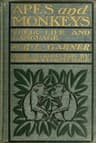
Apes and Monkeys: Their Life and Language
1900

Apes and Monkeys: Their Life and Language
1900
This is a pioneering work in ethology, written when the scientific study of animal behavior was in its infancy. R. L. Garner was among the first researchers to observe primates in their natural habitats rather than merely in captivity, and his observations challenge the assumption that humans alone possess complex social structures, intelligence, and the seeds of language. The book documents detailed observations of ape and monkey behavior, their communication methods, social hierarchies, and cognitive abilities, arguments that would influence later researchers like Jane Goodall and Frans de Waal. Garner writes with conviction that humans are not separate from the animal kingdom but connected to it, a radical position in 1900. The text reads as both scientific record and philosophical argument, making the case that the boundary between human and animal is far thinner than previously believed. For readers interested in the history of science, animal cognition, or the origins of ethology, this book offers a window into how Victorian-era naturalists began dismantling the wall between human and animal minds.
Editions
Link to this book
Add a free, dofollow link to Lex on your blog, forum, syllabus, or reading list.

<a href="https://lex-books.com/book/apes-and-monkeys-their-life-and-language-6bf6ba38-0272-44f2-8b35-155ea11000c0"><img src="https://lex-books.com/badges/read-on-lex.svg" alt="Read Apes and Monkeys: Their Life and Language by R. L. Garner free on Lex" width="160" height="40"></a>[](https://lex-books.com/book/apes-and-monkeys-their-life-and-language-6bf6ba38-0272-44f2-8b35-155ea11000c0)[url=https://lex-books.com/book/apes-and-monkeys-their-life-and-language-6bf6ba38-0272-44f2-8b35-155ea11000c0][img]https://lex-books.com/badges/read-on-lex.svg[/img][/url]Read Apes and Monkeys: Their Life and Language by R. L. Garner free on Lex: https://lex-books.com/book/apes-and-monkeys-their-life-and-language-6bf6ba38-0272-44f2-8b35-155ea11000c0Cite this book
Reading this edition for a paper or guide? Copy a citation.
Garner, R. L.. Apes and Monkeys: Their Life and Language. Lex, lex-books.com/book/apes-and-monkeys-their-life-and-language-6bf6ba38-0272-44f2-8b35-155ea11000c0.Garner, R. L. (1900). Apes and Monkeys: Their Life and Language. Lex. https://lex-books.com/book/apes-and-monkeys-their-life-and-language-6bf6ba38-0272-44f2-8b35-155ea11000c0Garner, R. L.. Apes and Monkeys: Their Life and Language. Lex. https://lex-books.com/book/apes-and-monkeys-their-life-and-language-6bf6ba38-0272-44f2-8b35-155ea11000c0.