Annals, Anecdotes and Legends: A Chronicle of Life Assurance
1718
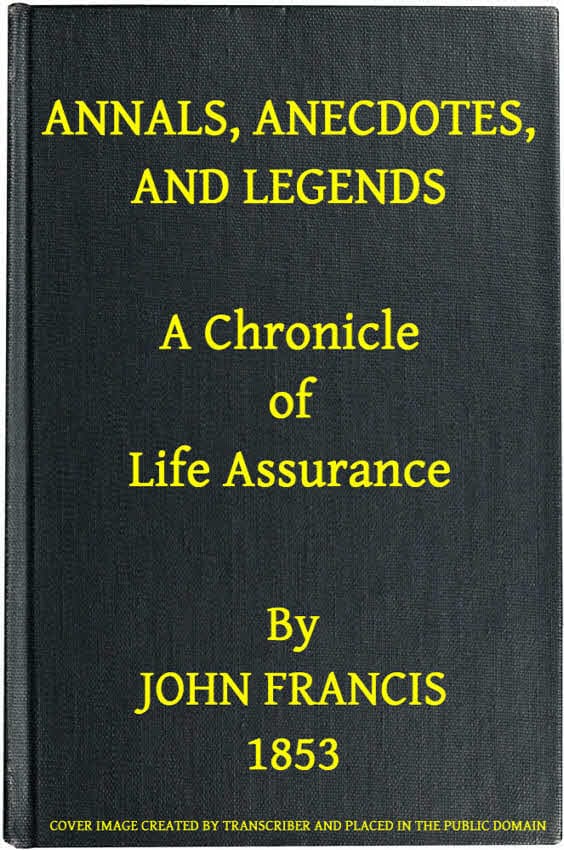
Annals, Anecdotes and Legends: A Chronicle of Life Assurance
John, of the Bank of England Francis
1718
Before life insurance became Wall Street boilerplate, it was a radical act of defiance against death itself. John Francis of the Bank of England traces the improbable birth of actuarial thought through the seventeenth and early eighteenth centuries, when a handful of unlikely visionaries dared to put a price on human life. We meet Captain John Graunt, a London haberdasher who became history's first statistician by meticulously counting corpses in weekly "bills of mortality" - finding terrible poetry in the patterns of death and giving humanity its first tools for predicting survival. Then comes the economist Sir William Petty, whose theories transformed human existence into capital, setting the stage for insurance to become a financial institution. Francis renders vivid the precarious world that birthed these ideas: an era when plague, war, and poverty made average lifespans horrifyingly short, when the concept of insuring against death seemed almost sacrilegious. This is financial history as intellectual adventure, showing how the mathematics of mortality emerged not from cold calculation but from a deep human need to soften mortality's brutal randomness.
Editions
Link to this book
Add a free, dofollow link to Lex on your blog, forum, syllabus, or reading list.

<a href="https://lex-books.com/book/annals-anecdotes-and-legends-a-chronicle-of-life-assurance-1d7b2f6b-ba2e-4c9e-ae4f-ee6915ecb811"><img src="https://lex-books.com/badges/read-on-lex.svg" alt="Read Annals, Anecdotes and Legends: A Chronicle of Life Assurance by John, of the Bank of England Francis free on Lex" width="160" height="40"></a>[](https://lex-books.com/book/annals-anecdotes-and-legends-a-chronicle-of-life-assurance-1d7b2f6b-ba2e-4c9e-ae4f-ee6915ecb811)[url=https://lex-books.com/book/annals-anecdotes-and-legends-a-chronicle-of-life-assurance-1d7b2f6b-ba2e-4c9e-ae4f-ee6915ecb811][img]https://lex-books.com/badges/read-on-lex.svg[/img][/url]Read Annals, Anecdotes and Legends: A Chronicle of Life Assurance by John, of the Bank of England Francis free on Lex: https://lex-books.com/book/annals-anecdotes-and-legends-a-chronicle-of-life-assurance-1d7b2f6b-ba2e-4c9e-ae4f-ee6915ecb811Cite this book
Reading this edition for a paper or guide? Copy a citation.
John, of the Bank of England Francis. Annals, Anecdotes and Legends: A Chronicle of Life Assurance. Lex, lex-books.com/book/annals-anecdotes-and-legends-a-chronicle-of-life-assurance-1d7b2f6b-ba2e-4c9e-ae4f-ee6915ecb811.John, O. T. B. O. E. F. (1718). Annals, Anecdotes and Legends: A Chronicle of Life Assurance. Lex. https://lex-books.com/book/annals-anecdotes-and-legends-a-chronicle-of-life-assurance-1d7b2f6b-ba2e-4c9e-ae4f-ee6915ecb811John, of the Bank of England Francis. Annals, Anecdotes and Legends: A Chronicle of Life Assurance. Lex. https://lex-books.com/book/annals-anecdotes-and-legends-a-chronicle-of-life-assurance-1d7b2f6b-ba2e-4c9e-ae4f-ee6915ecb811.