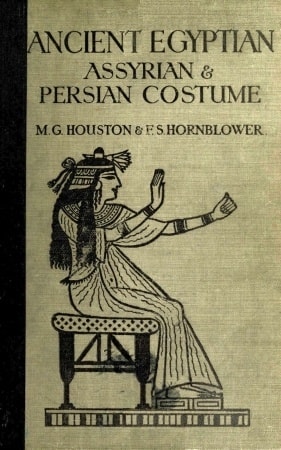
Ancient Egyptian, Assyrian, and Persian Costumes and Decorations
1920
Ancient Egyptian, Assyrian, and Persian Costumes and Decorations
1920
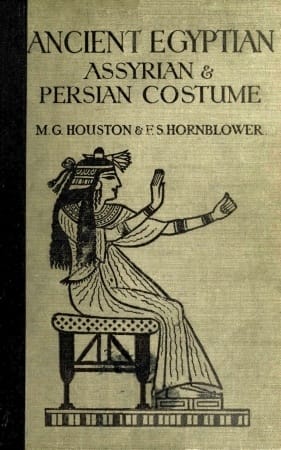
Few artifacts speak as eloquently about a civilization as its clothing. The ancient Egyptians, Assyrians, and Persians dressed themselves in garments that were engineering marvels, status markers, and sacred declarations all at once, and this 1920 reference work remains one of the most meticulous records of those textile traditions. Mary G. Houston catalogued the construction techniques, materials, and decorative systems of three of the ancient world's most fashion-forward cultures, from the draped linens of Egyptian pharaohs to the elaborate patterned robes of Persian nobility. The book offers not just descriptions but actual patterns and diagrams, twenty-five illustrations (sixteen in vivid color) that allow modern designers and historians to reconstruct these garments with confidence. What emerges is a picture of ancient peoples deeply intentional about appearance: linen that breathed in desert heat, wool reserved for the wealthy and forbidden in temples, headdresses that announced rank, jewelry that warded off evil. Whether you are a costume designer crafting an ancient epic, an artist seeking historical accuracy, or a reader curious about how people lived and presented themselves three millennia ago, this book opens a remarkably tangible window onto worlds otherwise known only through stone and papyrus.
Editions
X-Ray
Primary author and costume historian who conducted extensive research on ancient dress. She personally cut out and constructed each garment before sketching to ensure accuracy.
Co-author who specialized in historic ornament and decoration. She created the exact drawings and colorings of various decorative styles and colored the costume illustrations.
Ancient Egyptian queen depicted in Plate II wearing a tunic with braces, shown dressed as a goddess.
Egyptian god depicted in Plate IV wearing a simple ungirded robe, representing the 'Type of the Robe' in Egyptian costume.
About Ancient Egyptian, Assyrian, and Persian Costumes and Decorations
Chapter Summaries
- Introduction
- Houston explains the book's methodology of cutting and constructing each garment before illustration, emphasizing practical accuracy over comprehensive survey. She outlines the work's value for designers, students, and educators.
- 1
- Establishes four main Egyptian costume types: tunic, robe, skirt with cape, and shawl/drapery. Discusses materials (primarily linen), decoration methods, and the similarity between male and female dress styles.
- 2
- Detailed analysis of specific Egyptian garments from 3700 B.C. to A.D. 200, including goddess and royal costumes, tunics with braces, robes, and complex shawl draperies. Includes comparison with modern Indian sari.
Key Themes
- Historical Accuracy and Methodology
- The authors emphasize rigorous research methods, personally constructing each garment before illustration and verifying dates at the British Museum. This commitment to accuracy over convenience demonstrates scholarly integrity in historical documentation.
- Cultural Continuity and Change
- The text reveals how costume styles evolved slowly over centuries, with older forms persisting alongside newer innovations. This demonstrates the conservative nature of dress traditions and their role in cultural identity.
- Practical Application of Historical Knowledge
- The work bridges academic research and practical use, providing detailed cutting patterns for theatrical productions, pageantry, and modern fashion inspiration. This makes historical knowledge accessible and useful for contemporary purposes.
Characters
- Mary G. Houston(protagonist)
- Primary author and costume historian who conducted extensive research on ancient dress. She personally cut out and constructed each garment before sketching to ensure accuracy.
- Florence S. Hornblower(major)
- Co-author who specialized in historic ornament and decoration. She created the exact drawings and colorings of various decorative styles and colored the costume illustrations.
- Cleopatra(minor)
- Ancient Egyptian queen depicted in Plate II wearing a tunic with braces, shown dressed as a goddess.
- Osiris(minor)
- Egyptian god depicted in Plate IV wearing a simple ungirded robe, representing the 'Type of the Robe' in Egyptian costume.
- Ani(minor)
- Egyptian scribe from 1450 B.C. shown in Plate V wearing a draped and girded robe with elaborate sash arrangement.
- Thuthu(minor)
- Wife of Ani, depicted in Plate VI wearing a woman's robe tied in a knot under the breast rather than girded with a sash.
Link to this book
Add a free, dofollow link to Lex on your blog, forum, syllabus, or reading list.

<a href="https://lex-books.com/book/ancient-egyptian-assyrian-and-persian-costumes-and-decorations-e79794ca-6fc7-4a2c-bda5-0278fc3db4ac"><img src="https://lex-books.com/badges/read-on-lex.svg" alt="Read Ancient Egyptian, Assyrian, and Persian Costumes and Decorations by Mary G. Houston free on Lex" width="160" height="40"></a>[](https://lex-books.com/book/ancient-egyptian-assyrian-and-persian-costumes-and-decorations-e79794ca-6fc7-4a2c-bda5-0278fc3db4ac)[url=https://lex-books.com/book/ancient-egyptian-assyrian-and-persian-costumes-and-decorations-e79794ca-6fc7-4a2c-bda5-0278fc3db4ac][img]https://lex-books.com/badges/read-on-lex.svg[/img][/url]Read Ancient Egyptian, Assyrian, and Persian Costumes and Decorations by Mary G. Houston free on Lex: https://lex-books.com/book/ancient-egyptian-assyrian-and-persian-costumes-and-decorations-e79794ca-6fc7-4a2c-bda5-0278fc3db4acCite this book
Reading this edition for a paper or guide? Copy a citation.
Houston, Mary G.. Ancient Egyptian, Assyrian, and Persian Costumes and Decorations. Lex, lex-books.com/book/ancient-egyptian-assyrian-and-persian-costumes-and-decorations-e79794ca-6fc7-4a2c-bda5-0278fc3db4ac.Houston, M. G. (1920). Ancient Egyptian, Assyrian, and Persian Costumes and Decorations. Lex. https://lex-books.com/book/ancient-egyptian-assyrian-and-persian-costumes-and-decorations-e79794ca-6fc7-4a2c-bda5-0278fc3db4acHouston, Mary G.. Ancient Egyptian, Assyrian, and Persian Costumes and Decorations. Lex. https://lex-books.com/book/ancient-egyptian-assyrian-and-persian-costumes-and-decorations-e79794ca-6fc7-4a2c-bda5-0278fc3db4ac.