Abandonment; Or, Absolute Surrender to Divine Providence
1675
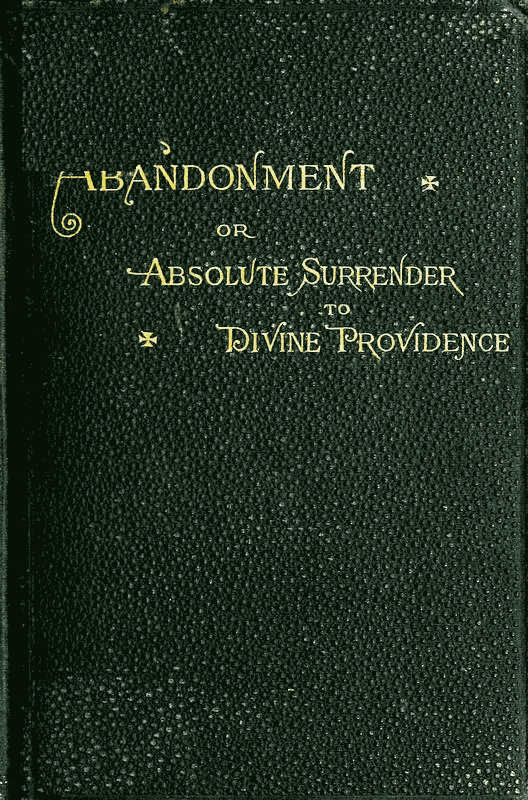
Abandonment; Or, Absolute Surrender to Divine Providence
1675
Translated by Ella McMahon
In 17th-century France, a Jesuit spiritual director wrote letters to a convent of nuns that would eventually become one of the most radical spiritual texts in Christian history. Jean Pierre de Caussade's masterpiece argues that God exists not in the future or afterlife, but in this very moment, and that true holiness comes from surrendering completely to divine providence. Written originally as practical guidance for the Visitation Sisters of Nancy navigating their spiritual struggles, the work offers two distinct movements: first, a theoretical foundation for what Caussade calls "absolute abandonment," and second, concrete practices for living in radical trust. The book directly engages with the aftermath of the Quietist controversy, clarifying how surrender differs from passive fatalism. What makes this text endure is its counterintuitive claim: that true freedom lies not in struggling against life's hardships but in accepting them as expressions of God's will. For modern readers weary of spiritual striving, this 18th-century masterpiece offers something surprising: permission to stop, breathe, and trust that the present moment contains everything needed.
Editions
X-Ray
“There is not a moment in which God does not present Himself under the cover of some pain to be endured, of some consolation to be enjoyed, or of some duty to be performed. All that takes place within us, around us, or through us, contains and conceals His divine action.””
— Jean Pierre de,Caussade
“To escape the distress caused by regret for the past or fear about the future, this is the rule to follow: leave the past to the infinite mercy of God, the future to His good Providence, give the present wholly to His love by being faithful to His grace.””
— Jean Pierre de,Caussade
“All simple souls must admire and respect one another, saying: 'Let us proceed each one along our path to the same goal, united in purpose and by means of God's order which, in its great variety, is in us all.””
— Jean Pierre de,Caussade
“God teaches the soul by pains and obstacles, not by ideas.””
— Jean Pierre de,Caussade
“If the work of our sanctification presents us with difficulties that appear insurmountable, it is because we do not look at it in the right way. In reality, holiness consists in one thing alone, namely, fidelity to God's plan. And this fidelity is equally within everyone's capacity in both its active and passive exercise.””
— Jean Pierre de,Caussade
“The books the Holy Spirit is writing are living, and every soul a volume in which the divine author makes a true revelation of his word, explaining it to every heart, unfolding it in every moment.””
— Jean Pierre de,Caussade
“The duties of each moment are the shadows beneath which hides the divine operation.””
— Jean Pierre de,Caussade
“In the state of abandonment the only rule is the duty of the present moment. In this the soul is light as a feather, liquid as water, simple as a child, active as a ball in receiving and following all the inspirations of grace. Such souls have no more consistence and rigidity than molten metal. As this takes any form according to the mould into which it is poured, so these souls are pliant and easily receptive of any form that God chooses to give them. In a word, their disposition resembles the atmosphere, which is affected by every breeze; or water, which flows into any shaped vessel exactly filling every crevice. They are before God like a perfectly woven fabric with a clear surface; and neither think, nor seek to know what God will be pleased to trace thereon, because they have confidence in Him, they abandon themselves to Him, and, entirely absorbed by their duty, they think not of themselves, nor of what may be necessary for them, nor of how to obtain it.””
— Jean Pierre de,Caussade
“I must not, like the quietists, reduce all religion to a denial of any specific action, despising all other means, since what makes perfection is God's order, and the means he ordains is best for the soul.””
— Jean Pierre de,Caussade
Link to this book
Add a free, dofollow link to Lex on your blog, forum, syllabus, or reading list.

<a href="https://lex-books.com/book/abandonment-or-absolute-surrender-to-divine-providence-54c288f7-d1ad-4c9b-9e5f-f255ab1bcc04"><img src="https://lex-books.com/badges/read-on-lex.svg" alt="Read Abandonment; Or, Absolute Surrender to Divine Providence by Jean Pierre de,Caussade free on Lex" width="160" height="40"></a>[](https://lex-books.com/book/abandonment-or-absolute-surrender-to-divine-providence-54c288f7-d1ad-4c9b-9e5f-f255ab1bcc04)[url=https://lex-books.com/book/abandonment-or-absolute-surrender-to-divine-providence-54c288f7-d1ad-4c9b-9e5f-f255ab1bcc04][img]https://lex-books.com/badges/read-on-lex.svg[/img][/url]Read Abandonment; Or, Absolute Surrender to Divine Providence by Jean Pierre de,Caussade free on Lex: https://lex-books.com/book/abandonment-or-absolute-surrender-to-divine-providence-54c288f7-d1ad-4c9b-9e5f-f255ab1bcc04Cite this book
Reading this edition for a paper or guide? Copy a citation.
Jean Pierre de,Caussade. Abandonment; Or, Absolute Surrender to Divine Providence. Lex, lex-books.com/book/abandonment-or-absolute-surrender-to-divine-providence-54c288f7-d1ad-4c9b-9e5f-f255ab1bcc04.Jean Pierre de, C. (1675). Abandonment; Or, Absolute Surrender to Divine Providence. Lex. https://lex-books.com/book/abandonment-or-absolute-surrender-to-divine-providence-54c288f7-d1ad-4c9b-9e5f-f255ab1bcc04Jean Pierre de,Caussade. Abandonment; Or, Absolute Surrender to Divine Providence. Lex. https://lex-books.com/book/abandonment-or-absolute-surrender-to-divine-providence-54c288f7-d1ad-4c9b-9e5f-f255ab1bcc04.