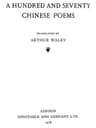
A Hundred and Seventy Chinese Poems

In 1918, Arthur Waley revolutionized how English readers encountered Chinese poetry. Rather than retranslating the familiar classics, he sought out poems that had never appeared in English before, and when he did tackle familiar territory, he improved what he considered inadequate versions. The result is a window into a poetic tradition that had been largely closed to Western readers: works spanning centuries, from named poets and anonymous singers, rendered in spare, exact English that preserves the strange compression of the original. These are poems of sudden feeling and precise observation. A soldier leaves at dawn. A woman watches the moon from her window. Friends part at a roadside inn. The wind moves through bamboo. Snow falls on a lonely river. Waley's translations strip away Victorian ornamentation, giving English readers access to the stark, image-driven beauty that made these poems endure in China for generations. The collection moves from poems of battle and separation to verses of nature and nostalgia, each one a complete world in a few lines. Waley believed translation should make you feel the foreignness of the original, not smooth it away. That tension, between accessibility and authenticity, is what gives this collection its power. A century later, it remains the best introduction to classical Chinese poetry in English.
Editions
Link to this book
Add a free, dofollow link to Lex on your blog, forum, syllabus, or reading list.

<a href="https://lex-books.com/book/a-hundred-and-seventy-chinese-poems-457b00c8-d763-4ccd-a604-459af09f95ce"><img src="https://lex-books.com/badges/read-on-lex.svg" alt="Read A Hundred and Seventy Chinese Poems by Unknown free on Lex" width="160" height="40"></a>[](https://lex-books.com/book/a-hundred-and-seventy-chinese-poems-457b00c8-d763-4ccd-a604-459af09f95ce)[url=https://lex-books.com/book/a-hundred-and-seventy-chinese-poems-457b00c8-d763-4ccd-a604-459af09f95ce][img]https://lex-books.com/badges/read-on-lex.svg[/img][/url]Read A Hundred and Seventy Chinese Poems by Unknown free on Lex: https://lex-books.com/book/a-hundred-and-seventy-chinese-poems-457b00c8-d763-4ccd-a604-459af09f95ceCite this book
Reading this edition for a paper or guide? Copy a citation.
Unknown. A Hundred and Seventy Chinese Poems. Lex, lex-books.com/book/a-hundred-and-seventy-chinese-poems-457b00c8-d763-4ccd-a604-459af09f95ce.Unknown (n.d.). A Hundred and Seventy Chinese Poems. Lex. https://lex-books.com/book/a-hundred-and-seventy-chinese-poems-457b00c8-d763-4ccd-a604-459af09f95ceUnknown. A Hundred and Seventy Chinese Poems. Lex. https://lex-books.com/book/a-hundred-and-seventy-chinese-poems-457b00c8-d763-4ccd-a604-459af09f95ce.


![Birds and Nature, Vol. 12 No. 1 [June 1902]illustrated by Color Photography](/_next/image?url=https%3A%2F%2Fd3b2n8gj62qnwr.cloudfront.net%2FCOVERS%2Fgutenberg_covers75k%2Febook-47881.png&w=3840&q=75)