A History of Economic Doctrines: From the Time of the Physiocrats to the Present Day
1915
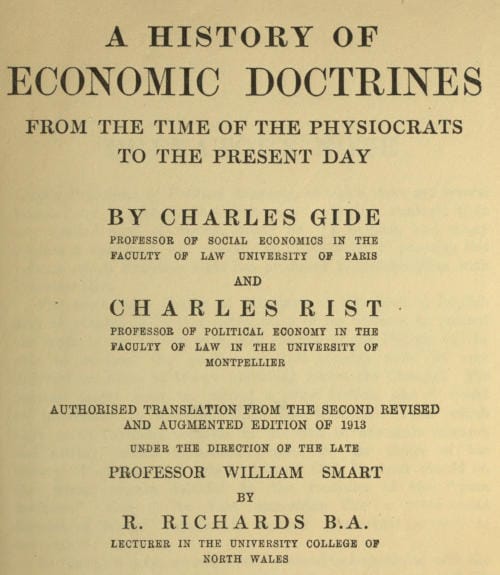
A History of Economic Doctrines: From the Time of the Physiocrats to the Present Day
1915
Translated by R. (Robert) Richards
Economic ideas have shaped revolutions, wars, and the modern world. Understanding where these ideas came from illuminates why we argue about capitalism, labor, and wealth the way we do today. Charles Gide maps the terrain of economic imagination across two centuries, revealing how each theorist responded to the crises and contradictions of their moment. From the Physiocrats' faith in natural order and land as the source of all wealth, through Smith's elegant invisible hand, Malthus's grim arithmetic of population, Mill's attempt to reconcile liberty with reform, and Marx's devastating critique of capital, each chapter shows ideas as living things, fighting for survival in a world that tests them. The book ends with the anarchists and the unresolved tensions that still define our economic debates. Written in 1915, it carries the weight of seeing economics as it entered the twentieth century - both its power and its blind spots. For anyone who wants to understand why we think about money, work, and markets the way we do.
Editions
Link to this book
Add a free, dofollow link to Lex on your blog, forum, syllabus, or reading list.

<a href="https://lex-books.com/book/a-history-of-economic-doctrines-from-the-time-of-the-physiocrats-to-the-present--93ebab99-469f-4722-b69e-28a01023dbfb"><img src="https://lex-books.com/badges/read-on-lex.svg" alt="Read A History of Economic Doctrines: From the Time of the Physiocrats to the Present Day by Charles Gide free on Lex" width="160" height="40"></a>[](https://lex-books.com/book/a-history-of-economic-doctrines-from-the-time-of-the-physiocrats-to-the-present--93ebab99-469f-4722-b69e-28a01023dbfb)[url=https://lex-books.com/book/a-history-of-economic-doctrines-from-the-time-of-the-physiocrats-to-the-present--93ebab99-469f-4722-b69e-28a01023dbfb][img]https://lex-books.com/badges/read-on-lex.svg[/img][/url]Read A History of Economic Doctrines: From the Time of the Physiocrats to the Present Day by Charles Gide free on Lex: https://lex-books.com/book/a-history-of-economic-doctrines-from-the-time-of-the-physiocrats-to-the-present--93ebab99-469f-4722-b69e-28a01023dbfbCite this book
Reading this edition for a paper or guide? Copy a citation.
Gide, Charles. A History of Economic Doctrines: From the Time of the Physiocrats to the Present Day. Lex, lex-books.com/book/a-history-of-economic-doctrines-from-the-time-of-the-physiocrats-to-the-present--93ebab99-469f-4722-b69e-28a01023dbfb.Gide, C. (1915). A History of Economic Doctrines: From the Time of the Physiocrats to the Present Day. Lex. https://lex-books.com/book/a-history-of-economic-doctrines-from-the-time-of-the-physiocrats-to-the-present--93ebab99-469f-4722-b69e-28a01023dbfbGide, Charles. A History of Economic Doctrines: From the Time of the Physiocrats to the Present Day. Lex. https://lex-books.com/book/a-history-of-economic-doctrines-from-the-time-of-the-physiocrats-to-the-present--93ebab99-469f-4722-b69e-28a01023dbfb.