A Chronicle of Jails
1917
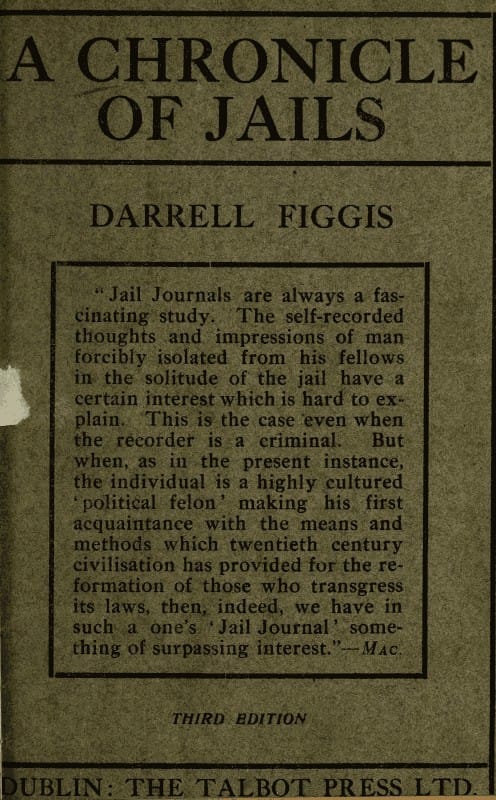
A Chronicle of Jails
1917
Among the flood of memoirs that followed the 1916 Easter Rising, Darrell Figgis's account stands apart for its specificity. Figgis was not merely swept up in the arrests that followed the rebellion. The British identified him as "leadership material" and bundled him off to Reading Gaol rather than the more infamous internment camp at Frongoch where hundreds of other suspects were held. This distinction matters, and it shapes everything about this visceral memoir. Written in 1917 while the wounds were still fresh, A Chronicle of Jails captures the disorientation of a free man becoming a prisoner. Figgis moves through the physical reality of incarceration, the cells, the silence, the loss, with the intensity of someone living it rather than recounting it. But this is not neutral observation. The memoir wears its propagandistic intent on its sleeve: it argues for the righteousness of the cause, for the honor of political prisoners, against the machinery of British repression. This makes it a more complicated and ultimately more revealing document than a straightforward historical account. It tells us not just what happened, but how participants understood themselves. For readers interested in the psychological dimensions of political imprisonment, or in the texture of revolutionary Ireland beyond the familiar narratives, Figgis offers something precious: a voice from inside the cage, still angry, still unrepentant.
Editions

Link to this book
Add a free, dofollow link to Lex on your blog, forum, syllabus, or reading list.

<a href="https://lex-books.com/book/a-chronicle-of-jails-6409bfff-0d4c-4aa8-b167-00c21bf0b72b"><img src="https://lex-books.com/badges/read-on-lex.svg" alt="Read A Chronicle of Jails by Darrell Figgis free on Lex" width="160" height="40"></a>[](https://lex-books.com/book/a-chronicle-of-jails-6409bfff-0d4c-4aa8-b167-00c21bf0b72b)[url=https://lex-books.com/book/a-chronicle-of-jails-6409bfff-0d4c-4aa8-b167-00c21bf0b72b][img]https://lex-books.com/badges/read-on-lex.svg[/img][/url]Read A Chronicle of Jails by Darrell Figgis free on Lex: https://lex-books.com/book/a-chronicle-of-jails-6409bfff-0d4c-4aa8-b167-00c21bf0b72bCite this book
Reading this edition for a paper or guide? Copy a citation.
Figgis, Darrell. A Chronicle of Jails. Lex, lex-books.com/book/a-chronicle-of-jails-6409bfff-0d4c-4aa8-b167-00c21bf0b72b.Figgis, D. (1917). A Chronicle of Jails. Lex. https://lex-books.com/book/a-chronicle-of-jails-6409bfff-0d4c-4aa8-b167-00c21bf0b72bFiggis, Darrell. A Chronicle of Jails. Lex. https://lex-books.com/book/a-chronicle-of-jails-6409bfff-0d4c-4aa8-b167-00c21bf0b72b.