A Boy's Experience in the Civil War, 1860-1865
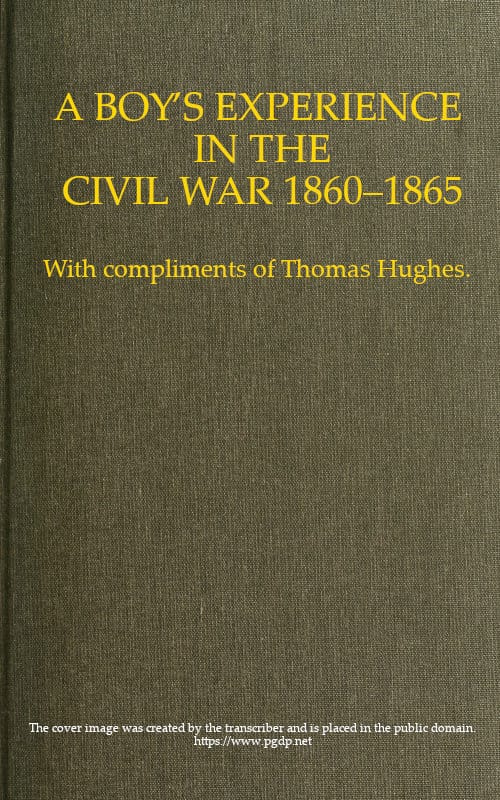
Thomas Hughes was twelve years old when his father, a physician, newspaperman, and Confederate legislator, brought the family to Richmond in 1862. What followed was an upbringing unlike most Southern children of the era: dinner parties with Jefferson Davis, horseback rides alongside Jeb Stuart, and a front-row seat to the collapse of a civilization. Hughes recalls his time at the Virginia Military Institute, the luxury that persisted even as Richmond starved, and the peculiar intimacy of a child moving among the most powerful men in the Confederacy. The memoir spans the war years and extends into Reconstruction, where Hughes watches Northern "opportunists" descend on a broken South. His elegy for the antebellum world is unflinching in its idealization, presenting plantation life as "a perfect community" and slavery as "an almost ideal life" - passages that demand the modern reader hold historical testimony and moral accountability in tension. This is not a history of battles but a portrait of a world seen from inside its privileged core, filtered through the fading memory of a man writing decades later. For readers seeking the Civil War from the Confederate drawing room rather than the battlefield, this memoir offers an indispensable and troubling perspective.
Editions

Link to this book
Add a free, dofollow link to Lex on your blog, forum, syllabus, or reading list.

<a href="https://lex-books.com/book/a-boy-s-experience-in-the-civil-war-1860-1865-2583e745-db9e-4026-a060-a43f7ef628c2"><img src="https://lex-books.com/badges/read-on-lex.svg" alt="Read A Boy's Experience in the Civil War, 1860-1865 by Thomas Hughes free on Lex" width="160" height="40"></a>[](https://lex-books.com/book/a-boy-s-experience-in-the-civil-war-1860-1865-2583e745-db9e-4026-a060-a43f7ef628c2)[url=https://lex-books.com/book/a-boy-s-experience-in-the-civil-war-1860-1865-2583e745-db9e-4026-a060-a43f7ef628c2][img]https://lex-books.com/badges/read-on-lex.svg[/img][/url]Read A Boy's Experience in the Civil War, 1860-1865 by Thomas Hughes free on Lex: https://lex-books.com/book/a-boy-s-experience-in-the-civil-war-1860-1865-2583e745-db9e-4026-a060-a43f7ef628c2Cite this book
Reading this edition for a paper or guide? Copy a citation.
Hughes, Thomas. A Boy's Experience in the Civil War, 1860-1865. Lex, lex-books.com/book/a-boy-s-experience-in-the-civil-war-1860-1865-2583e745-db9e-4026-a060-a43f7ef628c2.Hughes, T. (n.d.). A Boy's Experience in the Civil War, 1860-1865. Lex. https://lex-books.com/book/a-boy-s-experience-in-the-civil-war-1860-1865-2583e745-db9e-4026-a060-a43f7ef628c2Hughes, Thomas. A Boy's Experience in the Civil War, 1860-1865. Lex. https://lex-books.com/book/a-boy-s-experience-in-the-civil-war-1860-1865-2583e745-db9e-4026-a060-a43f7ef628c2.