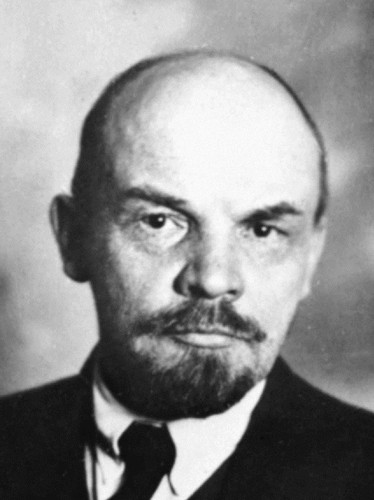
Vladimir Ilyich Lenin
Vladimir Ilyich Lenin was a revolutionary leader and political theorist who played a pivotal role in the establishment of the Soviet Union. Born in 1870 in Simbirsk, Russia, he became involved in revolutionary politics at a young age, influenced by his brother's execution for plotting to assassinate Tsar Alexander III. Lenin's commitment to Marxism led him to develop his own interpretations of Marxist theory, which he articulated in works such as 'What Is to Be Done?' and 'The State and Revolution.' His ideas emphasized the need for a vanguard party to lead the proletariat in overthrowing the capitalist system, a concept that would shape the course of 20th-century communism. In 1917, Lenin returned to Russia from exile and spearheaded the Bolshevik Revolution, which resulted in the overthrow of the provisional government and the establishment of a communist regime. As the leader of the new Soviet state, he implemented significant reforms, including the nationalization of industry and land redistribution. Lenin's leadership faced numerous challenges, including civil war and foreign intervention, yet he remained a central figure in the consolidation of Soviet power until his death in 1924. His legacy is marked by the profound impact he had on global politics, inspiring revolutionary movements worldwide and shaping the ideological landscape of the 20th century, despite the controversies surrounding his methods and the authoritarian nature of his regime.
Books from the author

Link to this page
Add a free, dofollow link to Lex on your blog, forum, syllabus, or reading list.

<a href="https://lex-books.com/author/vladimir-ilyich-lenin"><img src="https://lex-books.com/badges/read-on-lex.svg" alt="Vladimir Ilyich Lenin on Lex" width="160" height="40"></a>[](https://lex-books.com/author/vladimir-ilyich-lenin)[url=https://lex-books.com/author/vladimir-ilyich-lenin][img]https://lex-books.com/badges/read-on-lex.svg[/img][/url]Vladimir Ilyich Lenin on Lex: https://lex-books.com/author/vladimir-ilyich-lenin