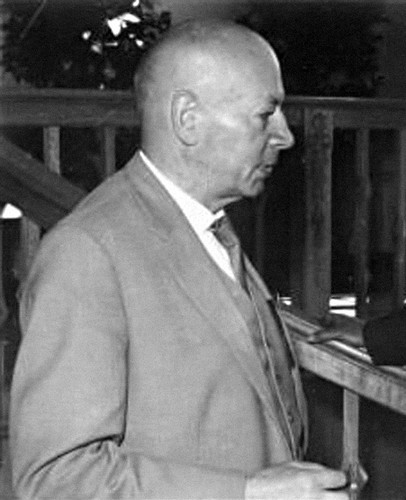
Erich Kamke
18 August 1890 – 28 September 1961
15 works on record
Biography
Erich Kamke (August 18, 1890 – September 28, 1961) was a German mathematician, who specialized in the theory of differential equations. Also, his book on set theory became a standard introduction to the field
Kamke was born in Marienburg, West Prussia, German Empire (modern Malbork, Poland).
After attending school in Stettin, Kamke studied mathematics and physics from 1909 at the University of Giessen and the University of Göttingen. He was a volunteer in the signals force in World War I. In 1919, he married Dora Heimowitch, who was the daughter of a Jewish businessman. He earned his doctorate in 1919 at the University of Göttingen under Edmund Landau with thesis Verallgemeinerungen des Waring-Hilbertschen Satzes (Generalizations of the Waring-Hilbert theorem).[1] While teaching between 1920 and 1926, Kamke earned his habilitation at the University of Münster in 1922. He was appointed as a professor at the University of Tübingen in 1926.
Because of his marriage and his opposition to National Socialism, he was denounced by fellow mathematician Erich Schönhardt and eventually forced to retire in 1937.[2]
Following World War II, he was reappointed as a professor at the University of Tübingen, and was instrumental in the organisation of a mathematical congress in Tübingen in autumn 1946, the first scientific congress in Germany after the war. In 1948, he re-established the German Mathematical Society, and was the chairman until 1952, when he became vice-president of the International Mathematical Union, which he remained until 1954.
He died in Rottenburg am Neckar from a heart attack.
Source: Wikipedia
Works
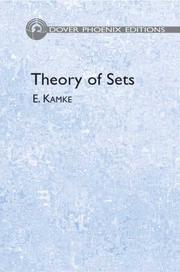
Mengenlehre
1928

Theory of sets

Differentialgleichungen
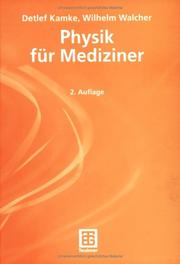
Physik Für Mediziner

Physikalische Grundlagen der Masseinheiten
Differentialgleichungen: Loesungsmethoden Und Loesungen
Differentialgleichungen, Lösungsmethoden und Lösungen
Differentialgleichungen, Lösungsmethoden und Lösungen
1965
Das Lebesgue-Stieltjes-Integral
Das Lebesgue-Stieltjes-Integral
1956
Differentialgleichungen, Lösungsmethoden und Lösungen
Differentialgleichungen, Lösungsmethoden und Lösungen
1940
Einführung in die wahrscheinlichkeitstheorie
Einführung in die wahrscheinlichkeitstheorie
1932
Differentialgleichungen reeller Funktionen
Differentialgleichungen reeller Funktionen
1930
Das Lebesguesche Integral
Das Lebesguesche Integral
1925
Das Lebesgue-Stieltjes Integral
Das Lebesgue-Stieltjes Integral
Einführung in die Wahrscheinlichkeitstheorie
Einführung in die Wahrscheinlichkeitstheorie
Einführung in die Kernphysik
Einführung in die Kernphysik