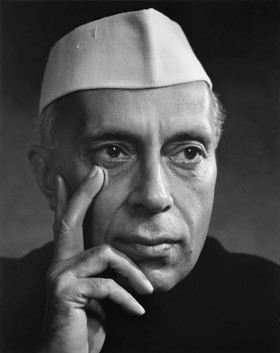
Nehru, Jawaharlal, 1889-1964
Jawaharlal Nehru was an influential Indian statesman and a key figure in the Indian independence movement. Born into a prominent family in Allahabad, he was educated at Harrow and Cambridge University, where he developed a keen interest in politics and social issues. Nehru's early exposure to the ideas of socialism and nationalism shaped his vision for India, leading him to join the Indian National Congress and work closely with Mahatma Gandhi. His writings during this period, including 'The Discovery of India,' reflect his deep understanding of India's cultural heritage and his aspirations for a modern, democratic nation. As India's first Prime Minister, Nehru played a pivotal role in shaping the country's policies and identity post-independence. He championed secularism, industrialization, and a non-aligned foreign policy, positioning India as a leader among newly independent nations. His literary contributions, particularly his letters and speeches, are notable for their eloquence and vision, emphasizing the importance of science, rationality, and social justice. Nehru's legacy endures not only through his political achievements but also through his writings, which continue to inspire generations in India and beyond.
Books from the author

Link to this page
Add a free, dofollow link to Lex on your blog, forum, syllabus, or reading list.

<a href="https://lex-books.com/author/jawaharlal-nehru"><img src="https://lex-books.com/badges/read-on-lex.svg" alt="Nehru, Jawaharlal, 1889-1964 on Lex" width="160" height="40"></a>[](https://lex-books.com/author/jawaharlal-nehru)[url=https://lex-books.com/author/jawaharlal-nehru][img]https://lex-books.com/badges/read-on-lex.svg[/img][/url]Nehru, Jawaharlal, 1889-1964 on Lex: https://lex-books.com/author/jawaharlal-nehru