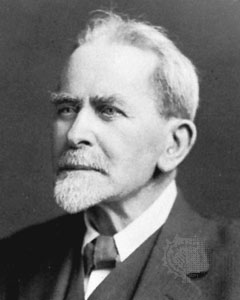
James Frazer
James Frazer was a Scottish social anthropologist and folklorist, best known for his seminal work, 'The Golden Bough.' Published in 1890, this extensive study of mythology and religion explored the parallels between ancient rituals and contemporary beliefs, arguing that human societies evolve through stages of magic, religion, and science. Frazer's comparative approach to anthropology laid the groundwork for future studies in the field, influencing thinkers such as Sigmund Freud and Carl Jung, who drew upon his insights into the human psyche and cultural practices. Frazer's contributions extended beyond 'The Golden Bough'; his other notable works include 'Totemism and Exogamy' and 'The Belief in Immortality and the Worship of the Dead.' His exploration of the connections between myth, ritual, and belief systems provided a framework for understanding the complexities of human culture. Although some of his theories have been critiqued or fallen out of favor, Frazer's impact on anthropology and the study of religion remains significant, as he opened the door for interdisciplinary dialogue and the examination of cultural practices across different societies. His legacy endures in the fields of anthropology, religious studies, and literary criticism, where his ideas continue to provoke thought and discussion.
Famous Quotes
View all 17 quotes“Small minds cannot grasp great ideas; to their narrow comprehension, their purblind vision, nothing seems really great and important but themselves.””
“The propensity to excessive simplification is indeed natural to the mind of man, since it is only by abstraction and generalisation, which necessarily imply the neglect of a multitude of particulars, that he can stretch his puny faculties so as to embrace a minute portion of the illimitable vastness of the universe. But if the propensity is natural and even inevitable, it is nevertheless fraught with peril, since it is apt to narrow and falsify our conception of any subject under investigation. To correct it partially - for to correct it wholly would require an infinite intelligence - we must endeavour to broaden our views by taking account of a wide range of facts and possibilities; and when we have done so to the utmost of our power, we must still remember that from the very nature of things our ideas fall immeasurably short of the reality.””
“By religion, then, I understand a propitiation or conciliation of powers superior to man which are believed to direct and control the course of nature and of human life. Thus defined, religion consists of two elements, a theoretical and a practical, namely, a belief in powers higher than man and an attempt to propitiate or please them. Of the two, belief clearly comes first, since we must believe in the existence of a divine being before we can attempt to please him. But unless the belief leads to a corresponding practice, it is not a religion but merely a theology; in the language of St. James, “faith, if it hath not works, is dead, being alone.” In other words, no man is religious who does not govern his conduct in some measure by the fear or love of God. On the other hand, mere practice, divested of all religious belief, is also not religion. Two men may behave in exactly the same way, and yet one of them may be religious and the other not. If the one acts from the love or fear of God, he is religious; if the other acts from the love or fear of man, he is moral or immoral according as his behaviour comports or conflicts with the general good.””
Books from the author




Link to this page
Add a free, dofollow link to Lex on your blog, forum, syllabus, or reading list.

<a href="https://lex-books.com/author/james-frazer"><img src="https://lex-books.com/badges/read-on-lex.svg" alt="James Frazer on Lex" width="160" height="40"></a>[](https://lex-books.com/author/james-frazer)[url=https://lex-books.com/author/james-frazer][img]https://lex-books.com/badges/read-on-lex.svg[/img][/url]James Frazer on Lex: https://lex-books.com/author/james-frazer