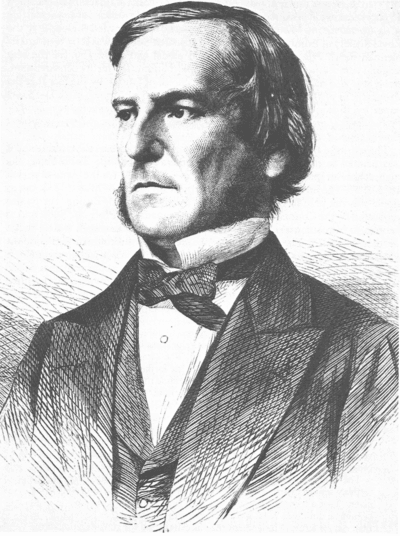
George Boole
George Boole was an English mathematician, philosopher, and logician, renowned for his groundbreaking work in algebraic logic and differential equations. As the first professor of mathematics at Queen's College, Cork, he made significant contributions to the foundations of modern logic and computer science. His most notable work, 'The Laws of Thought' (1854), introduced Boolean algebra, a revolutionary framework that underpins digital circuit design and programming. Boole's journey began in humble circumstances; the son of a shoemaker, he was largely self-taught, starting his teaching career at the age of 16 to support his family. He later established his own school and became an influential figure in the mathematical community, collaborating with peers and engaging in local social causes. Throughout his career, Boole published around 50 articles and several important treatises, including 'The Mathematical Analysis of Logic' and 'Treatise on Differential Equations'. His work not only advanced the study of logic but also laid the groundwork for future developments in probability theory and linear differential equations. Boole's legacy endures as a pioneer of symbolic logic, and his ideas continue to shape the fields of mathematics and computer science, marking him as a pivotal figure in the transition to the Information Age.
Famous Quotes
View all 3 quotes“A distinguished writer [Siméon Denis Poisson] has thus stated the fundamental definitions of the science: 'The probability of an event is the reason we have to believe that it has taken place, or that it will take place.' 'The measure of the probability of an event is the ratio of the number of cases favourable to that event, to the total number of cases favourable or contrary, and all equally possible' (equally like to happen). From these definitions it follows that the word probability, in its mathematical acceptation, has reference to the state of our knowledge of the circumstances under which an event may happen or fail. With the degree of information which we possess concerning the circumstances of an event, the reason we have to think that it will occur, or, to use a single term, our expectation of it, will vary. Probability is expectation founded upon partial knowledge. A perfect acquaintance with all the circumstances affecting the occurrence of an event would change expectation into certainty, and leave neither room nor demand for a theory of probabilities.”
“There was yet another disadvantage attaching to the whole of Newton’s physical inquiries, ... the want of an appropriate notation for expressing the conditions of a dynamical problem, and the general principles by which its solution must be obtained. By the labours of LaGrange, the motions of a disturbed planet are reduced with all their complication and variety to a purely mathematical question. It then ceases to be a physical problem; the disturbed and disturbing planet are alike vanished: the ideas of time and force are at an end; the very elements of the orbit have disappeared, or only exist as arbitrary characters in a mathematical formula.”
“There is a common ground upon which all sincere votaries of truth may meet, exchanging with each other the language of Flamsteed's appeal to Newton, "The works of the Eternal Providence will be better understood through your labors and mine.”
Books from the author
Link to this page
Add a free, dofollow link to Lex on your blog, forum, syllabus, or reading list.

<a href="https://lex-books.com/author/george-boole"><img src="https://lex-books.com/badges/read-on-lex.svg" alt="George Boole on Lex" width="160" height="40"></a>[](https://lex-books.com/author/george-boole)[url=https://lex-books.com/author/george-boole][img]https://lex-books.com/badges/read-on-lex.svg[/img][/url]George Boole on Lex: https://lex-books.com/author/george-boole