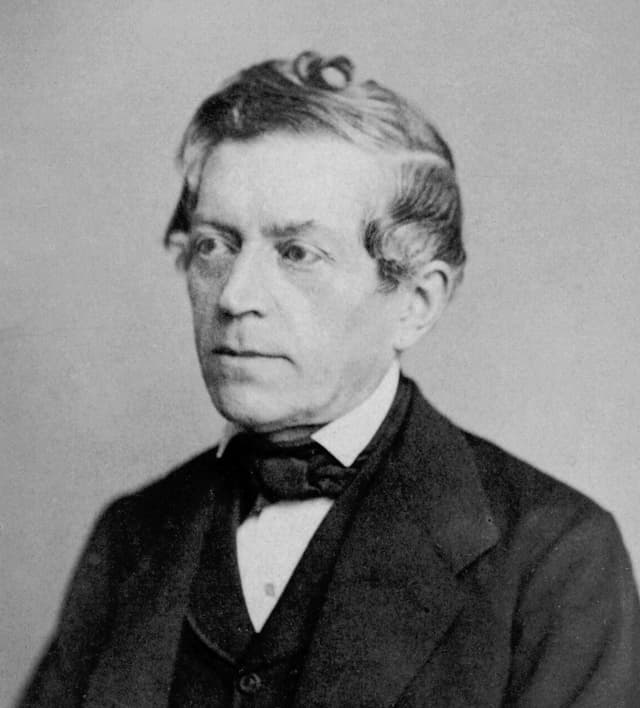
David Friedrich Strauss
David Friedrich Strauss was a prominent German theologian and writer known for his groundbreaking exploration of the historical Jesus. His seminal work, 'The Life of Jesus, Critically Examined,' published in 1835, challenged traditional views of the New Testament by applying critical historical methods to the life and teachings of Jesus. Strauss argued that the miracles attributed to Jesus could be understood as myths that conveyed deeper truths rather than mere fabrications. This innovative approach not only reshaped biblical scholarship but also sparked significant debate within Christian circles regarding the nature of faith and the interpretation of scripture. Associated with the Tübingen School, Strauss's ideas played a crucial role in the development of modern biblical criticism and the study of early Christianity. His emphasis on the mythological elements within religious texts opened new avenues for understanding the intersection of faith and historical context. Although his work was controversial and met with resistance from orthodox theologians, Strauss's contributions laid the groundwork for subsequent theological discourse and influenced later thinkers in both religious and secular fields. His legacy endures in the ongoing dialogue about the historical and theological dimensions of Christianity.
Famous Quotes
View all 2 quotes“The world ultimately is what we say it is.”
“Kant bases upon the fact, that in all religions old and new which are partly comprised in sacred books, intelligent and well-meaning teachers of the people have continued to explain them, until they have brought their actual contents into agreement with the universal principles of morality. Thus did the moral philosophers amongst the Greeks and Romans with their fabulous legends; till at last they explained the grossest polytheism as mere symbolical representations of the attributes of the one divine Being, and gave a mystical sense to the many vicious actions of their gods, [...] in order to bring the popular faith, which it was not expedient to destroy, into agreement with the doctrines of morality. The later Judaism and Christianity itself he thinks have been formed upon similar explanations, occasionally much forced, but always directed to objects undoubtedly good and necessary for all men. Thus the Mahometans gave a spiritual meaning to the sensual descriptions of their paradise, and thus the Hindoos, [...] interpreted their Vedas. In like manner, [...] the Christian Scriptures of the Old and New Testament, must be interpreted throughout in a sense which agrees with the universal practical laws of a religion of pure reason”
Books from the author

Link to this page
Add a free, dofollow link to Lex on your blog, forum, syllabus, or reading list.

<a href="https://lex-books.com/author/david-friedrich-strauss"><img src="https://lex-books.com/badges/read-on-lex.svg" alt="David Friedrich Strauss on Lex" width="160" height="40"></a>[](https://lex-books.com/author/david-friedrich-strauss)[url=https://lex-books.com/author/david-friedrich-strauss][img]https://lex-books.com/badges/read-on-lex.svg[/img][/url]David Friedrich Strauss on Lex: https://lex-books.com/author/david-friedrich-strauss