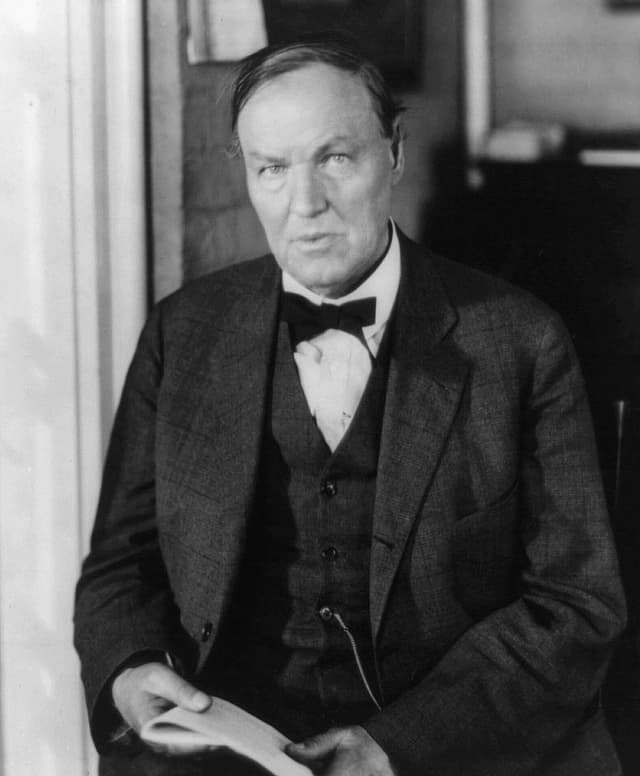
Clarence Darrow
Clarence Seward Darrow was an influential American lawyer renowned for his passionate defense of civil liberties and high-profile legal cases. Born in 1857, he gained prominence in the late 19th century through his advocacy for trade unions and later became a household name in the 20th century for his involvement in several landmark trials. Among his most notable cases were the defense of Nathan Leopold and Richard Loeb, two wealthy teenagers accused of murder, the Scopes 'monkey' trial that challenged the teaching of evolution in schools, and the defense of Ossian Sweet, an African American man accused of murder in a racially charged case. Darrow's legal acumen and compelling arguments often highlighted social injustices and the complexities of human behavior, making him a pivotal figure in American legal history. A leading member of the American Civil Liberties Union, Darrow was not only a skilled lawyer but also a gifted public speaker and writer. His advocacy for Georgist economic reform reflected his commitment to social equity. His legacy as a defender of individual rights and a critic of the legal system's shortcomings has earned him a place among the greatest lawyers of the 20th century, and he was posthumously inducted into the Trial Lawyer Hall of Fame. Darrow's wit, eloquence, and dedication to justice continue to inspire legal professionals and civil rights advocates today.
Famous Quotes
View all 3 quotes“Every instinct that is found in any man is in all men. The strength of the emotion may not be so overpowering, the barriers against possession not so insurmountable, the urge to accomplish the desire less keen. With some, inhibitions and urges may be neutralized by other tendencies. But with every being the primal emotions are there. All men have an emotion to kill; when they strongly dislike some one they involuntarily wish he was dead. I have never killed any one, but I have read some obituary notices with great satisfaction.”
“I have always felt that doubt was the beginning of wisdom, and the fear of God was the end of wisdom.”
“I do not consider it an insult, but rather a compliment to be called an agnostic. I do not pretend to know where many ignorant men are sure — that is all that agnosticism means.”
Books from the author





Link to this page
Add a free, dofollow link to Lex on your blog, forum, syllabus, or reading list.

<a href="https://lex-books.com/author/clarence-darrow"><img src="https://lex-books.com/badges/read-on-lex.svg" alt="Clarence Darrow on Lex" width="160" height="40"></a>[](https://lex-books.com/author/clarence-darrow)[url=https://lex-books.com/author/clarence-darrow][img]https://lex-books.com/badges/read-on-lex.svg[/img][/url]Clarence Darrow on Lex: https://lex-books.com/author/clarence-darrow