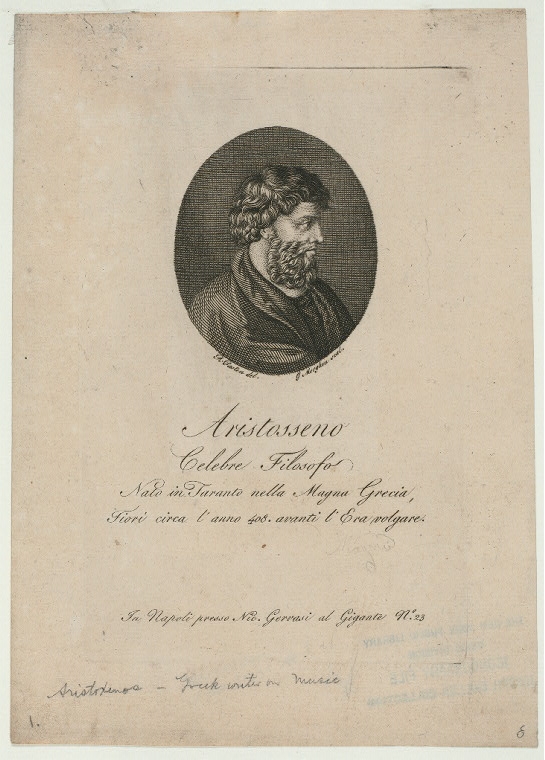
Aristoxenus
Aristoxenus was an ancient Greek philosopher and music theorist, notable for his contributions to the understanding of music and its relationship to philosophy. A student of Aristotle, he diverged from his teacher's emphasis on empirical observation, advocating instead for a more subjective approach to music theory, which he believed should be grounded in human perception and experience. His most significant work, the "Elements of Harmony," laid the groundwork for later developments in music theory, exploring concepts such as scales, intervals, and the emotional effects of music. Aristoxenus also wrote extensively on rhythm and melody, emphasizing the importance of practical musicianship alongside theoretical knowledge. His ideas were influential in the development of both music and philosophy in the Hellenistic period and beyond. Aristoxenus's approach to music as a science rooted in human experience marked a departure from the mathematical theories of earlier thinkers like Pythagoras. His legacy continued to resonate through the ages, impacting later philosophers and musicians, and his works were referenced by notable figures such as Boethius in the medieval period. Aristoxenus's unique perspective on music and its philosophical implications has secured his place as a pivotal figure in the history of music theory.
Books from the author

Link to this page
Add a free, dofollow link to Lex on your blog, forum, syllabus, or reading list.

<a href="https://lex-books.com/author/aristoxenus"><img src="https://lex-books.com/badges/read-on-lex.svg" alt="Aristoxenus on Lex" width="160" height="40"></a>[](https://lex-books.com/author/aristoxenus)[url=https://lex-books.com/author/aristoxenus][img]https://lex-books.com/badges/read-on-lex.svg[/img][/url]Aristoxenus on Lex: https://lex-books.com/author/aristoxenus