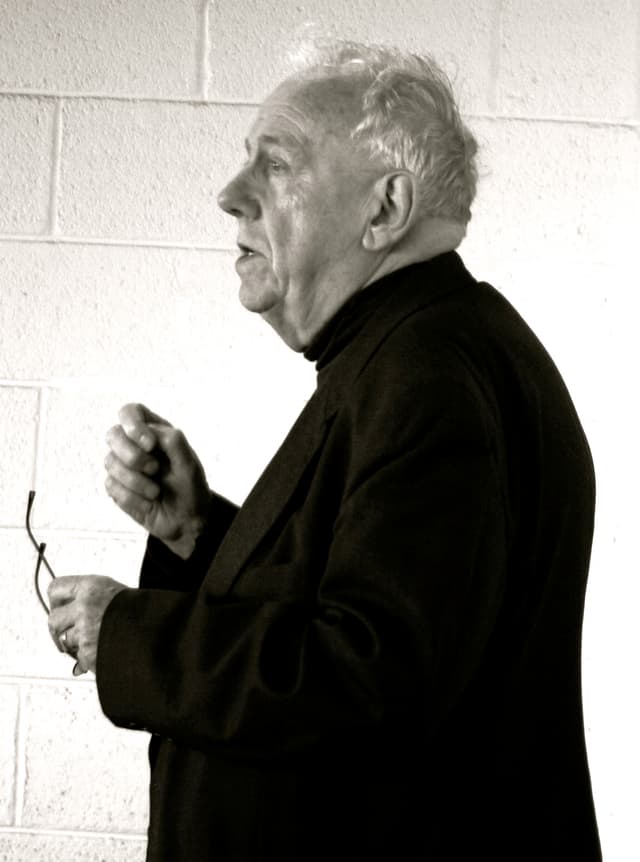
Alasdair MacIntyre
Alasdair MacIntyre was a Scottish-American philosopher renowned for his influential contributions to moral and political philosophy, as well as the history of philosophy and theology. His seminal work, 'After Virtue' (1981), is widely regarded as one of the most significant texts in Anglophone moral and political philosophy of the 20th century, challenging contemporary ethical theories and advocating for a return to Aristotelian ethics. Throughout his extensive academic career, MacIntyre held prestigious positions, including emeritus Professor of Philosophy at the University of Notre Dame and senior research fellow at the Centre for Contemporary Aristotelian Studies in Ethics and Politics in London. MacIntyre's philosophical inquiries often centered on the concept of virtue and the role of tradition in moral reasoning. His critiques of modernity and the fragmentation of moral discourse have sparked significant debate and have influenced a generation of philosophers, ethicists, and theologians. His work remains a cornerstone in discussions of virtue ethics, and his legacy continues to shape contemporary thought on morality and community.
Famous Quotes
View all 20 quotes“At the foundation of moral thinking lie beliefs in statements the truth of which no further reason can be given.””
“Imprisoning philosophy within the professionalizations and specializations of an institutionalized curriculum, after the manner of our contemporary European and North American culture, is arguably a good deal more effective in neutralizing its effects than either religious censorship or political terror””
“Charles II once invited the members of the Royal Society to explain to him why a dead fish weighs more than the same fish alive; a number of subtle explanations were offered to him. He then pointed out that it does not.””
Books from the author


Link to this page
Add a free, dofollow link to Lex on your blog, forum, syllabus, or reading list.

<a href="https://lex-books.com/author/alasdair-macintyre"><img src="https://lex-books.com/badges/read-on-lex.svg" alt="Alasdair MacIntyre on Lex" width="160" height="40"></a>[](https://lex-books.com/author/alasdair-macintyre)[url=https://lex-books.com/author/alasdair-macintyre][img]https://lex-books.com/badges/read-on-lex.svg[/img][/url]Alasdair MacIntyre on Lex: https://lex-books.com/author/alasdair-macintyre